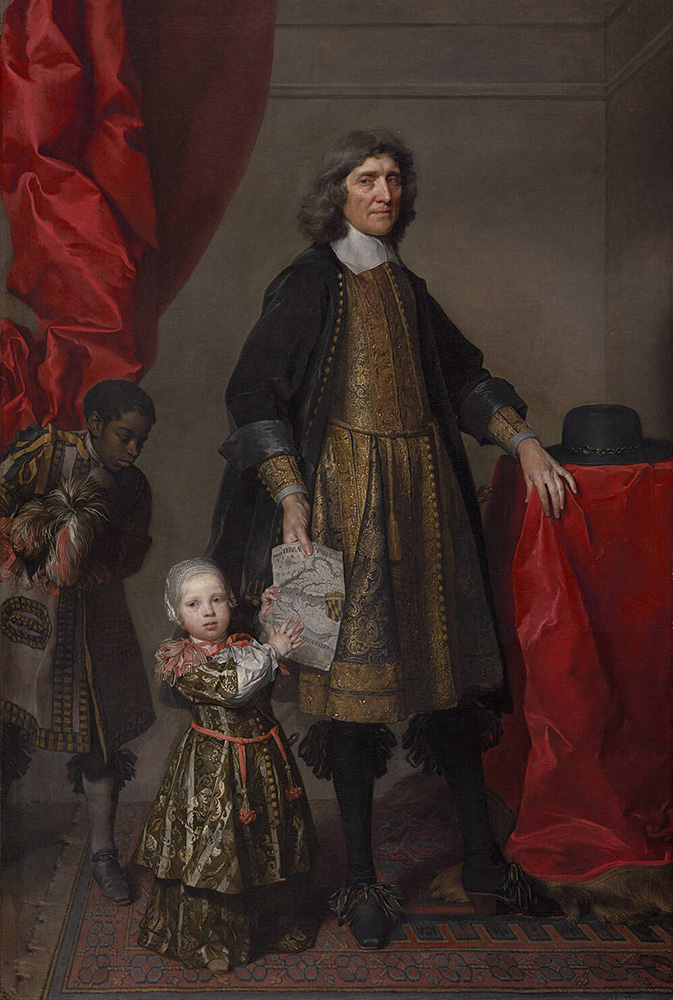
A painting of Cecil Calvert from circa 1670, painted by Gerard Soest.
Cecil (Cecilius) Calvert, Second Lord Baltimore (1605-1675)
Cecil Calvert was still a young man of 26 years when his father, Sir George Calvert, Lord Baltimore, passed away. When his father died, Cecil Calvert became the Second Baron of Baltimore. He also inherited the colonies and lands his father owned. In 1632, King Charles I approved George Calvert's request to establish a colony called the Province of Maryland (“Terra Mariae”).
Though King Charles I signed the Charter of Maryland for George Calvert, the Calvert family received the Charter after George Calvert died. It was now up to Cecil Calvert to establish and govern the new colony. C. Calvert was well educated, but he did not have his father’s years of experience governing colonies. No one knew what kind of leader C. Calvert might turn out to be when the king named him Lord Proprietor of Maryland. Cecil Calvert proved to be a wise leader. He invited sons of Catholic and Protestant families to sail to Maryland and establish the new colony. Each of these men brought their wives, children, and servants with them to the New World. Coming to Maryland as a family was very important to helping the colony grow and sustain itself.
Cecil Calvert wanted to join the colonists in the voyage, but had to stay in England. He was concerned that no one would be able to keep the king’s support for Maryland if he left the country. He sent his brother, Leonard, on the voyage and made him the colony’s first governor. Before Leonard sailed for Maryland in March 1633, Cecil gave his brother a set of instructions to help him with the colony’s government. This document, called “Instructions to the Colonists by Lord Baltimore,” became the basis of Maryland’s laws.1
Cecil Calvert wanted to make certain that Catholics and Protestants were treated fairly under the new system of government. He allowed both to practice their preferred religion. C. Calvert said that Catholics and Protestants should not be allowed to argue with each other about their beliefs. Cecil was Catholic and knew about the problems that Catholics and Protestants might have in living in the same town. He also advised the colonists about the layout of properties in their first town and about communications with the colonists in Virginia.
Cecil Calvert governed Maryland from his home in England. He lived with his wife Anne Arundell and their children. C. Calvert was never able to visit his colony because of the social and political problems in England. The English Parliament had so many disagreements with King Charles I during the 17th century that they fought a civil war against him between 1642 and 1649.
The English Civil War influenced events in Maryland because England's government was divided between those who supported the king and those who supported Parliament. C. Calvert wanted to make sure the Maryland colony would be protected no matter which side won the civil war. He made friends in Parliament, but he continued to support King Charles I for as long as he could.
Meanwhile, a Parliamentary supporter named Richard Ingle attacked St. Mary’s City in 1645. Ingle and his men took many of Maryland’s government and Catholic leaders prisoner. It took Cecil and Leonard Calvert almost a whole year to take control of Maryland again. Leonard died in 1647, and the colonists needed a new governor. In 1648, C. Calvert commissioned a Protestant named William Stone to go to Maryland to serve as the new governor.
Cecil Calvert’s choice of a Protestant governor was very important to Parliamentary leaders in England. This was his way of convincing Parliament that he was loyal, and Parliament allowed C. Calvert to remain the Proprietor of Maryland. On April 2, 1649, Cecil gave Governor Stone a new law to be voted on by the Maryland Assembly. This law is often called the "Maryland Toleration Act," but C. Calvert called it "An Act Concerning Religion." The Assembly put most of the Act of Toleration’s parts into law. The Act gave colonists freedom to worship any Christian faith, as long as they were loyal to Cecil Calvert and the civil government.
But a second civil war in England caused C. Calvert to lose control of Maryland again. From 1652 to 1655, Puritan Commissioners from the English Parliament fought against Governor Stone and his followers. The Commissioners forced Governor Stone to resign in 1655. This time it took Cecil two years to win back control of Maryland. People in Maryland enjoyed peace in the years following the restoration of C. Calvert’s title, Lord Proprietor of Maryland. Cecil Calvert sent his son, Charles Calvert, to be Maryland’s Governor in 1661. C. Calvert told his son to keep the Act of Toleration as law for the good of Maryland.2 Freedom of religion was essential to help the Maryland colonists live together in peace. Cecil Calvert died in 1675, after governing Maryland for forty-two years.
2COUNCIL OF MARYLAND (Proceedings), 1671-1675, Archives of Maryland, vol. 15, p. 13.
« Back to the Calvert Family Tree
Sources:
Krugler, J. D. (1984). "With promise of liberty in religion": The Catholic Lords Baltimore and toleration in seventeenth-century Maryland, 1634–1692. Maryland Historical Magazine, 79(1), 21–43.