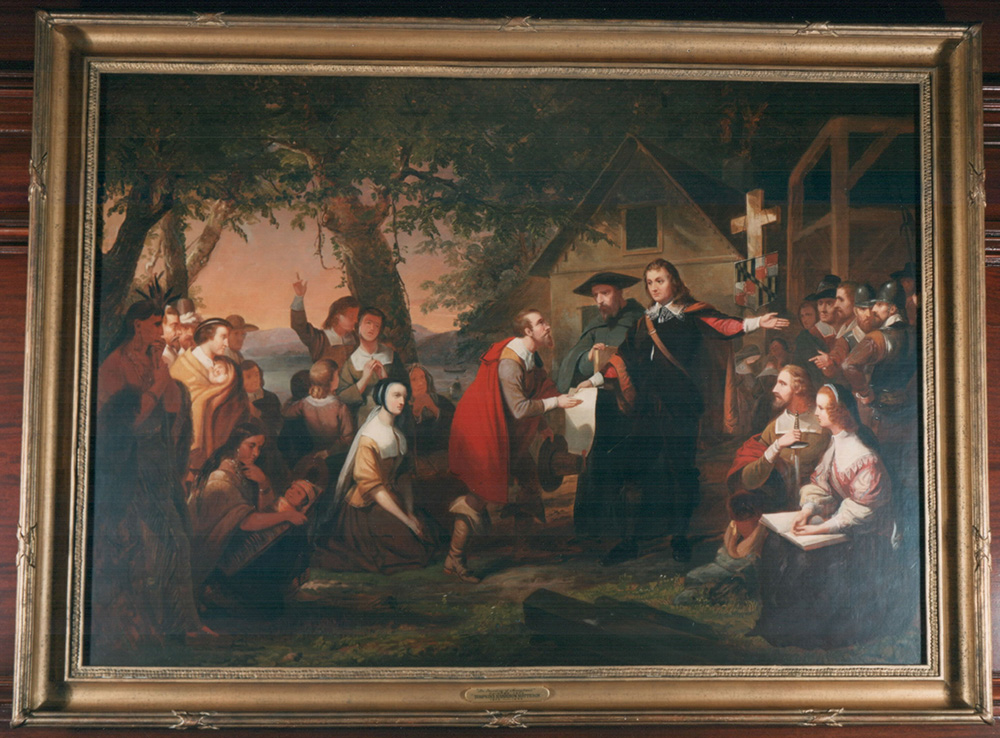
1853 painting titled Cecil Calvert Presenting the Acts of Toleration to Gov. William Stone, by Tompkins Harrison Matteson. William Stone appears in the red cloak and Verlinda directly behind him.
Gov. William Stone (c. 1603-c. 1659/60) and Verlinda Stone
William Stone served as Maryland’s first Protestant governor. Stone and his wife, Verlinda, both took action to preserve freedom of religion in Maryland.
William Stone was born in England around 1603 and came from a well-known merchant family in London. Later in life, William came to America, immigrating to Virginia in 1628. He was successful there, working as a merchant and planter. Stone was respected by his neighbors and was appointed justice of the peace and later sheriff in Accomack County, Virginia.
Stone also served as a burgess in the Virginia Assembly. However, when civil war broke out in England in 1642, many Protestants who supported Parliament were no longer welcome in Virginia. This is because the colony supported the King of England. At this time, Cecil Calvert, Lord Baltimore and the proprietor of Maryland, tried to attract more settlers to Maryland, and many Protestants left Virginia.
William Stone and his wife Verlinda came to Maryland in 1648. That same year, Stone was given a great opportunity. Civil war was still going on in England, and with many new Protestant settlers in Maryland, Lord Baltimore wanted to appoint a Protestant governor. He chose William Stone, likely in part to reward Stone for promising to bring hundreds of settlers to Maryland. Stone served as Maryland’s governor for six years until Puritans, a radical branch of Protestants, gained control of the government and passed laws that restricted religious freedom.
Stone fought back. He organized about 100 supporters and marched against the rebels in the Battle of Severn. He was greatly outnumbered, and after losing nearly half his men and being wounded in the shoulder, Stone surrendered. He was taken prisoner and held for over a month.
While Stone was in captivity, his wife, Verlinda, wrote to Lord Baltimore to make sure he understood exactly what had happened so he could protect both her husband and the colony. Stone was eventually released from prison and resumed his position as governor. He died in 1660, leaving 14,950 pounds of tobacco for his wife and seven children and a legacy to be remembered.
After her husband’s death, Verlinda acquired more land for her family. In 1664, she patented 300 acres of land in Charles County which she called “Virlinda.” Two years later, she bought 500 more acres in what is now Prince George’s County. She lived in the colony which she and her husband had fought to preserve until she died in 1675.
« Back to Library Collection
Sources:
Hall, C. C. (Ed.). (1910). Narratives of early Maryland, 1633–1684. Charles Scribner's Sons.
Maloney, E. J. (1996). Papists and Puritans in early Maryland: Religion in the forging of provincial society, 1632–1665 (Publication No. 9637195) [Doctoral dissertation, State University of New York at Stony Brook]. ProQuest Dissertations and Theses Global.
Papenfuse, E. C., Day, A. F., Jordan, D. W., & Stiverson, G. A. (1979–1985). A biographical dictionary of the Maryland legislature, 1635–1789 (Vols. 1–2). Johns Hopkins University Press.