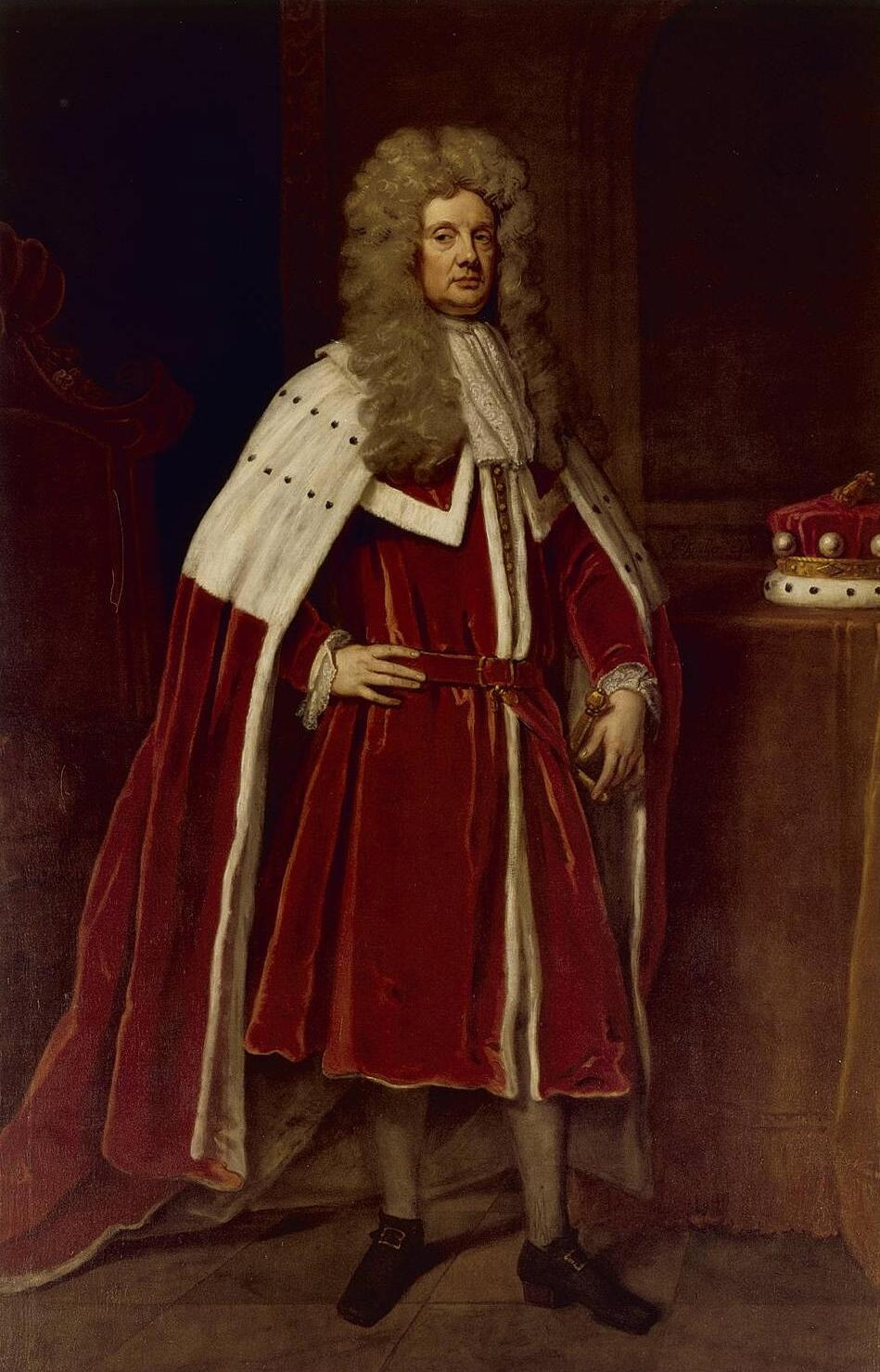
A painting of Charles Calvert from between 1675 and 1715, painted by Sir Godfrey Kneller.
Charles Calvert, Third Lord Baltimore (1637-1715)
Charles Calvert grew up knowing that he would someday become the Third Lord Baltimore and Proprietary Governor of Maryland. As the son of Cecil Calvert and Anne Arundell, Charles Calvert lived the privileged life of an English noble. Like the rest of his family, Charles Calvert was raised Roman Catholic.
As a young man, Charles Calvert witnessed the religious conflicts between Protestants and Catholics in the English Civil Wars from 1642 to 1651. He watched his father, Cecil Calvert, handle very difficult political situations to protect control of the Maryland Province. In 1661, Cecil Calvert sent 24-year-old Charles Calvert to Maryland. Charles Calvert replaced his uncle Philip Calvert as Governor of the Colony of Maryland. Philip Calvert then became Charles Calvert’s advisor in government affairs. Charles Calvert remained the colonial governor until his father died in 1675.
The Maryland colony's population and economy expanded quickly during Charles Calvert’s time in office. Charles Calvert created four new counties on the Eastern Shore. During his term as governor, Charles Calvert ordered many public projects to help Marylanders. He built courthouses, jails, roads, and highways. He improved the colony's defense by building magazines to store gunpowder. Under his administration, Maryland's government passed laws regulating how people could leave land to their heirs upon death. Charles Calvert also reformed the lower house in the Maryland Assembly, now called the House of Delegates. He restricted voting to men who owned property worth at least 40 pounds. He also ruled that only men who owned at least 1,000 acres of land could be elected as a delegate. He changed the voting requirements because he was concerned that less wealthy delegates might oppose the proprietary government.
Enslaved people’s lives were made more difficult under Charles Calvert’s government. During his term, the Assembly officially made slavery legal, and ordered that enslaved people must serve their masters for life.
In 1675, Cecil Calvert died in England. Charles Calvert inherited his father's lands, title, and government roles. He became the Third Baron of Baltimore and new Lord Proprietor of Maryland. He was the first member of the Calvert family to serve both as Maryland's Governor and Lord Proprietor. Charles went to England shortly after his father died, but returned to live in Maryland and oversee the colony personally.
During his years as proprietor, there was a boundary dispute between Maryland and William Penn's Quaker colony in Pennsylvania. Charles Calvert left Maryland and sailed back to England in 1684 to settle this dispute with William Penn. Before the boundary line could be verified, another revolution happened in England. Two Protestants, King William and Queen Mary, accepted joint rule of England. Since Charles Calvert was Catholic, the new king and queen took away his right to govern Maryland. Now Maryland was ruled directly by the English Monarchy and overseen by a royal governor. Charles Calvert died in 1715 before he could recover power over the Maryland colony. Later that year, King George I granted Charles Calvert’s grandson full proprietary rights to govern Maryland.
« Back to the Calvert Family Tree