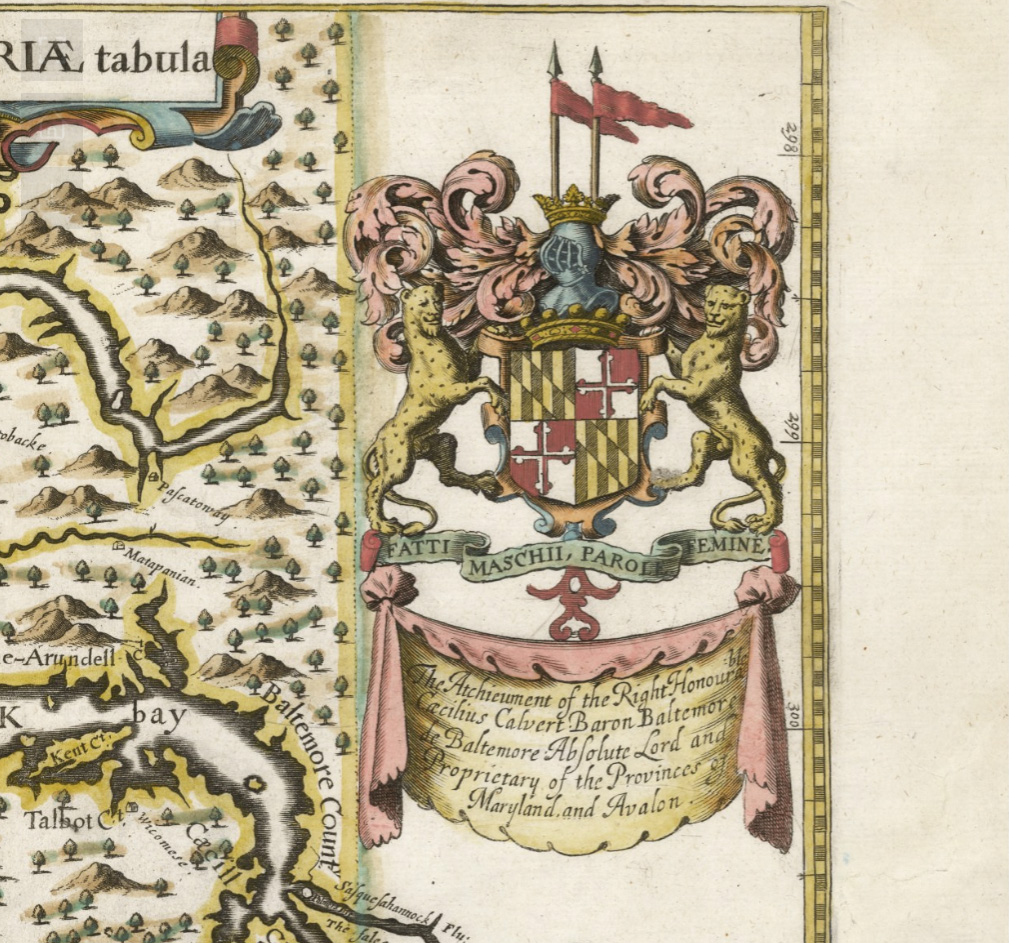
The Calvert Coat of Arms. There is no known image of Phillip Calvert.
Philip Calvert (1626-1682)
Philip Calvert was a younger son of George Calvert, the first Lord Baltimore. P. Calvert never inherited the “Lord Baltimore” title or his father’s proprietorship of Maryland, yet he played an important role in ensuring the colony's stability and successful development. P. Calvert was born in 1626 and was only six years old when his father died. He was placed in the care of his half-brother, Cecil Calvert, who became the second Lord Baltimore.
As a Catholic, Philip Calvert was not allowed to attend college in England. He went away to school at the English College in Lisbon, the capital of Portugal. In 1636, he married Anne Wolseley, the daughter of Sir Thomas Wolseley of Staffordshire, England. Like the Calverts, Anne Wolseley was a Catholic. In England, the king's soldiers had been fighting the Puritan supporters of Parliament in a civil war, creating tensions in the newly formed Maryland Colony. Radical Protestants, also known as Puritans, seized control of Maryland's government in 1654, but the English authorities returned the colony to the Calverts in 1657.
Maryland's government and the Calverts’ control over the colony remained unstable, and Lord Baltimore needed a man he could trust to run the colony. To avoid angering the Protestant settlers further, Lord Baltimore did not want to select a Catholic as governor. He named a Protestant, Josias Fendall, to be governor, but appointed his half-brother Philip Calvert as councilor, court justice, principal secretary, and judge of probate. This way, P. Calvert would have some control and could look after the Calvert family interest.
Philip Calvert and his wife Anne arrived in Maryland in 1656. For several years, he helped run the colony until the governor, Josias Fendall, tried to take control of Maryland for himself. His attempt failed, and P. Calvert became governor, helping to preserve peace and authority in the colony.
Unfortunately for P. Calvert, because he was George Calvert's younger son, he was not destined to rule for long. Lord Baltimore replaced him with his own son Charles. But because P. Calvert had done such a good job running the government, he was named chancellor, a position second only to Charles Calvert. Philip Calvert made important improvements in how the courts operated and helped pass laws to protect orphans in Maryland. He also helped ensure peace in the colony by negotiating with other countries and colonies and with local tribes that often fought with settlers.
Philip Calvert was not as famous or powerful as his half-brother Cecil Calvert or his nephew Charles Calvert, but he made important contributions to the Maryland colony. In doing so, he became wealthy and well respected. When he died in 1682, he lived in a large brick mansion and owned over 3900 acres of land in Maryland. The later discovery of his coffin in St. Mary's City led scientists to determine that Philip Calvert stood about 5'6" tall, was overweight, and had red hair or wore a red wig. He was right-handed and suffered from arthritis.
« Back to the Calvert Family Tree
Sources:
Carr, L. G., & Papenfuse, E. C. (n.d.). Biography [MSA SC 1138-199]. Historic St. Mary's City; Maryland State Archives.
Papenfuse, E. C., Day, A. F., Jordan, D. W., & Stiverson, G. A. (1979–1985). A biographical dictionary of the Maryland legislature, 1635–1789 (Vols. 1–2). Johns Hopkins University Press.
Maryland State Archives. (n.d.). Topic file: Lead coffins, St. Mary's City [MSA SC 1456-1945].