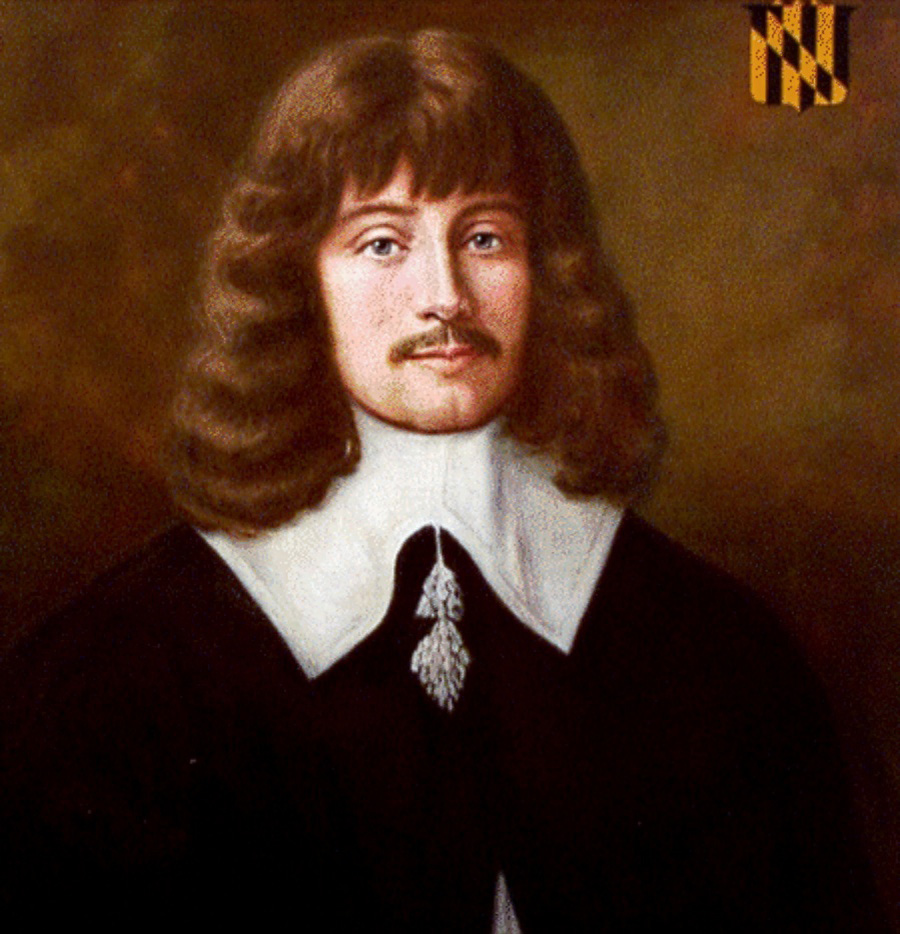
A painting of Leonard Calvert from 1914, painted by Florence Mackubin and based on a seventeenth-century portrait by an unknown artist.
Leonard Calvert (1606-1647)
In 1633, Leonard Calvert led the sailing expedition of the Ark and Dove to Maryland. His older brother, Cecil Calvert, Second Lord Baltimore, had appointed L. Calvert to be Maryland's first governor. L. Calvert carried with him a letter containing C. Calvert’s instructions. These instructions provided a set of laws for the colony and described how to establish Maryland's first elected Assembly.
As governor, L. Calvert oversaw Maryland's militia, sea forces, court system, and finances.1 L. Calvert hired Captain Henry Fleet in advance to act as a guide when they arrived. L. Calvert knew Captain Fleet would be a good guide because he had lived with Nacotchtanks and learned the Algonkian language spoken by many tribes in the area.2
In February 1634, the two ships approached the Chesapeake Bay for the first time. There, L. Calvert met up with Captain Fleet, and the two set out to meet with the village chiefs of the local Piscataway and Yaocomaco people before settling on the land. Algonkian-speaking people called their village or clan chiefs werowances. The Yaocomoco werowance agreed to sell a village to the Calverts in exchange for gifts, trading guarantees, and protection from their enemies, the Susquehannock and Iroquois. The Yaocomoco village property purchased by L. Calvert became the English settlement of St. Mary's City on March 27, 16343.
L. Calvert’s years as governor of the new colony were often difficult. William Claiborne went to the King of England and claimed that the Calvert family had no right to land in Maryland. Claiborne and his fellow Kent Islanders had settled there and established a trading post with the Native Americans in 1631. King Charles I ruled in favor of the Calverts, making Claiborne and other Virginians enemies of the Maryland colony. The Susquehannocks also raided and attacked English settlements and Piscataway villages during the 1630s and early 1640s.
L. Calvert did not stay in Maryland throughout his governorship. He left the colony twice to visit England: the winter of 1641 to 1642 and the winter of 1643 to 1644. He had a family in England, but because Catholic marriages were kept secret in England, historians do not know for certain who his wife was. Some historians believe that L. Calvert’s wife was Ann Brent, sister of Margaret and Giles Brent.4 We do know that L. Calvert had a son named William and a daughter named Anne who grew up in England.
To make matters worse for L. Calvert, the English Civil War came to the shores of the Chesapeake Bay in the 1640s. Parliamentary supporter, Captain Richard Ingle and his men attacked and plundered St. Mary's City in 1645, capturing some of Maryland's leaders. Some historians believe that Captain Ingle coordinated his attack with William Claiborne.5
Certainly, Ingle wanted to claim the Maryland colony for England's Parliament. L. Calvert escaped capture and controlled Maryland's armies from a headquarters in Virginia. L. Calvert and his militia restored proprietary control of the Maryland colony in 1647. However, L. Calvert died of an illness in the summer of the same year. Before he died, L. Calvert wrote a will naming Margaret Brent the executor of his estate. As executor, Margaret had to follow L. Calvert’s command to "Take all & pay all." This meant he told Margaret to use money from both his estate and his brother, Lord Baltimore's estate, to pay the militia men who had defended Maryland. L. Calvert also named Thomas Greene as the new governor of Maryland.
2Fausz, J. F. (1984). Present at the "creation": The Chesapeake world that greeted the Maryland colonists. Maryland Historical Magazine, 79(1), 7–20.
3Fausz, "Present at the 'creation'," 15.
4or example, see Edward C. Papenfuse et al, Biographical Dictionary of the Maryland Legislature, 190.
5Timothy B. Rioridan discusses evidence for Richard Ingle and William Claiborne's collaboration on the attack, The Plundering Time, 10-11 to 10-17. For a general description of the attacks on Maryland during the English Civil War, see Aubrey C. Land, Colonial Maryland — A History (Millwood, NY: KTO Press, 1981), 45-49.
« Back to the Calvert Family Tree
Sources:
Fausz, J. F. (1984, Spring). Present at the "creation": The Chesapeake world that greeted the Maryland colonists. Maryland Historical Magazine, 79(1), 7–20.
Papenfuse, E. C., Day, A. F., Jordan, D. W., & Stiverson, G. A. (1979–1985). A biographical dictionary of the Maryland legislature, 1635–1789 (Vols. 1–2). Johns Hopkins University Press.
Riordan, T. B. (2004). The plundering time: Maryland in the English Civil War, 1642–1650. Maryland Center for History and Culture.