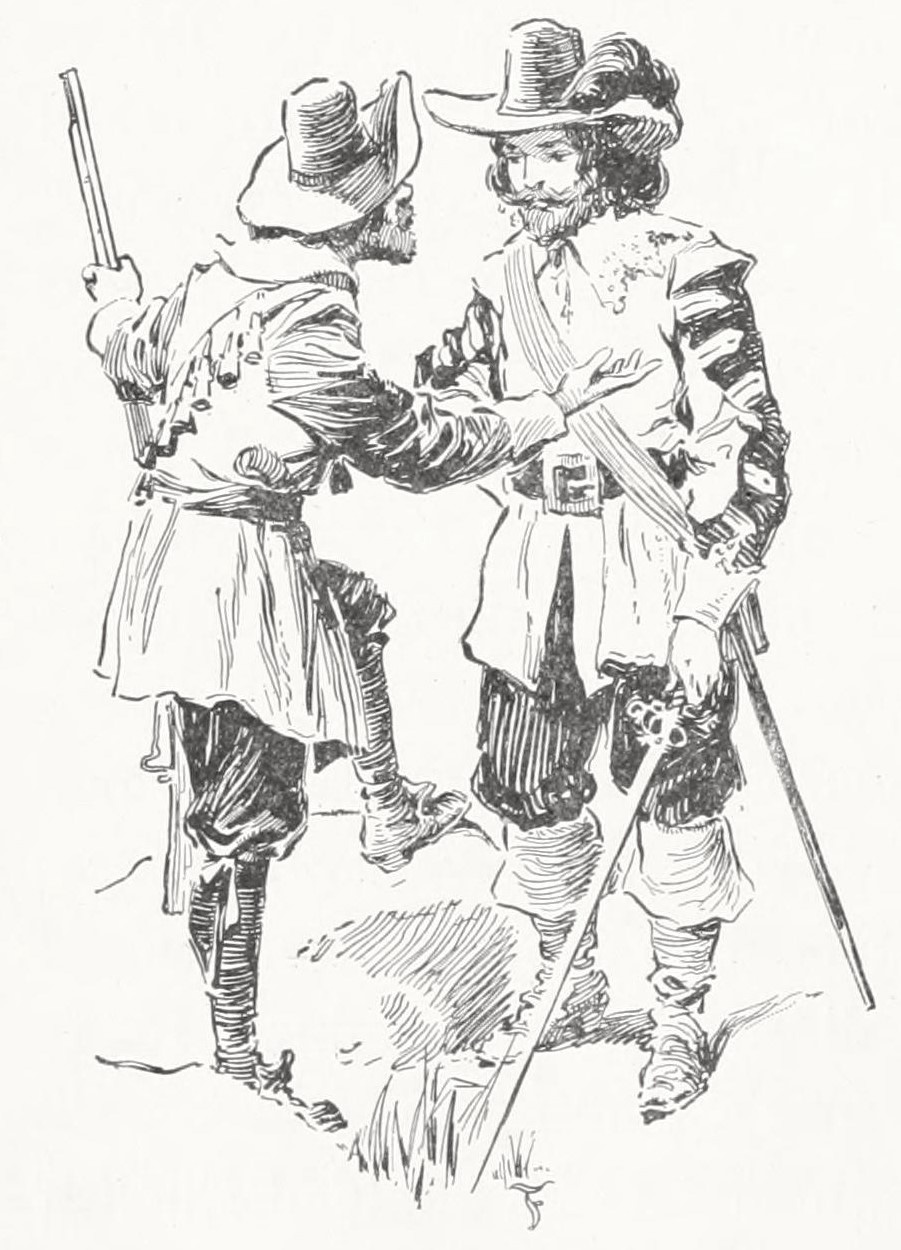
This 1910 textbook illustration shows Henry Fleet talking to Captain Richard Lowe in Virginia.
Captain Henry Fleet
Captain Henry Fleet explored the Chesapeake Bay region before the Maryland colonists arrived in 1634. Fleet was an English adventurer from a wealthy family. He came to the Virginia colony in 1621.
Fleet was interested in trading with the Patawomeke (Potomac) people who lived along the Potomac River near the modern-day site of Washington, D.C. In 1623, the Patawomekes’ enemies, the Nacotchtank (Anacostan), raided a Patawomeke village. They killed both Virginian settlers and Patawomekes and took the survivors captive. Captain Fleet was among the survivors.
The Nacotchtanks kept Fleet as their prisoner for five years. Eventually, the Virginia government paid the Nacotchtanks a ransom to release Fleet. During his captivity, Fleet carefully observed the Nacotchtanks. He even learned to speak their language, a local variation of Algonkian. After his release, Fleet used his experiences with the Nacotchtanks and skills as a sailor to earn his living.
In 1627, Fleet created a trading partnership with Indigenous villages. He acquired a trading ship, Paramour, and a crew with money invested by merchant William Clobbery. For several years, Fleet sailed along the Potomac River trading English goods with the local Indigenous tribes for animal furs and skins.1
When the Maryland colonists arrived in Virginia in 1634, Fleet agreed to act as a guide for Governor Leonard Calvert. He translated the Algonkian language into English when the governor first met with the Piscataways and Yaocomacos, natives of southern Maryland. Governor Calvert and the Werowance, or village chieftain, of the Yaocomacos agreed to an exchange: the Yaocomacos would give a village to Governor Calvert, and in return, Calvert promised to protect the Yaocomacos from their enemies. Captain Fleet helped make this exchange possible so that the Calverts had land to build St. Mary's City, the first capital of Maryland.2
The Calverts gave Fleet the rights to trade with the Piscataway for beaver skins in Maryland territory. On one trading mission for Lord Baltimore, Fleet sailed a ship called Deborah that was loaded with a valuable cargo of goods:
74 axes, 26 hoes, 19 yards of Dutch cloth, 16 pairs of Irish stockings, 2 yards of cloth [called "peak"], and a chest containing beads, knives, combs, fish hooks, Jew's harps [musical instruments], and looking glasses [mirrors].3
Captain Fleet's career demonstrates that traders served as important negotiators between the English and Chesapeake-area Indigenous populations.
2Hawley, J., & Lewger, J. (1910). A relation of Maryland (1635). In C. C. Hall (Ed.), Narratives of early Maryland, 1633–1684 (pp. 72–73). Charles Scribner's Sons. (Original work published 1635)
3Maryland State Archives. (1637, February 28). Proceedings of the General Assembly (Vol. 3, pp. 67–68). Archives of Maryland.
« Back to Library Collection
Sources:
Fausz, J. F. (1984). Present at the "creation": The Chesapeake world that greeted the Maryland colonists. Maryland Historical Magazine, 79(1), 7–20.5
Hawley, J., & Lewger, J. (1910). A relation of Maryland (1635). In C. C. Hall (Ed.), Narratives of early Maryland, 1633–1684 (pp. 72–73). Charles Scribner's Sons. (Original work published 1635)
Rountree, H. C., & Davidson, T. E. (1997). Eastern Shore Indians of Virginia and Maryland. University Press of Virginia.