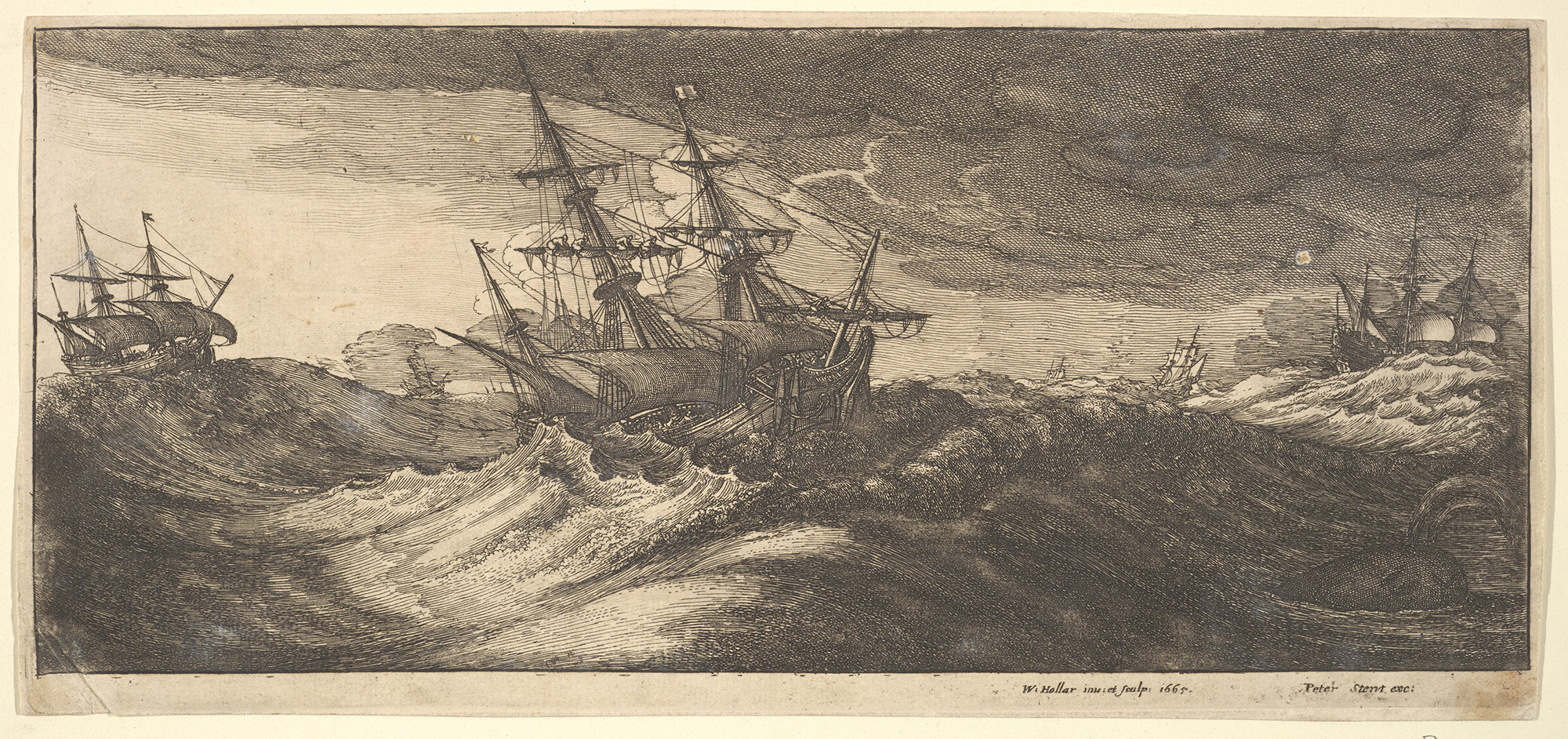
This 1665 etching by Wenceslaus Hollar shows what a ship like Richard Ingle's would have looked like at that time in history.
Richard Ingle (1609-1653)
Richard Ingle was sometimes called “that ungrateful Villaine” by those living in Maryland.1 When he took control of Maryland’s government in 1645, he allowed his men to destroy the property of many Catholic settlers, an act they would not soon forget.
Not much is known about Richard Ingle’s background. He was born in England and is believed to have come from a middle-class Protestant family. He could read, so he most likely had some schooling. Ingle eventually became a trader and a ship captain, transporting goods back and forth to England.
At first, Ingle was very friendly with the leaders of Maryland. At one point during his career, he was described as the chief trader to Maryland.2 However, when civil war broke out in England in 1642, Ingle sided with the radical Protestants, or Puritans, against King Charles I.
Ingle had a temper and was quick to get angry. After some disagreements with the Catholic leaders of Maryland, he decided to attack the colony in the name of Parliament. In 1645, he sailed his ship, the Reformation, to Maryland and attacked the settlement of St. Mary’s City. He took the colony's leaders as prisoners and brought two Jesuit priests — including Father Andrew White — back to England in chains.
Ingle claimed to have the permission of the new English government to attack the colony, but many colonists thought he was no better than a pirate. Wealthy Catholic settlers like Thomas Cornwallis had their property stolen or damaged by Ingle’s men during the unrest. Cornwallis estimated his losses to be £2623, a fortune in Maryland at the time. The English court forced Ingle to repay Cornwallis to make up for what he had taken in Maryland.
2Riordan, T. B. (1997). The plundering time: Maryland in the English Civil War, 1642–1650. [Unpublished manuscript]. Chapter 2, p.20.
« Back to Library Collection
Sources:
Maloney, E. J. (1996). Papists and Puritans in early Maryland: Religion in the forging of provincial society, 1632–1665 (Publication No. XXXXX) [Doctoral dissertation, State University of New York at Stony Brook]. ProQuest Dissertations and Theses Global.
Riordan, T. B. (2004). The plundering time: Maryland in the English Civil War, 1645–1646. Maryland Center for History and Culture.