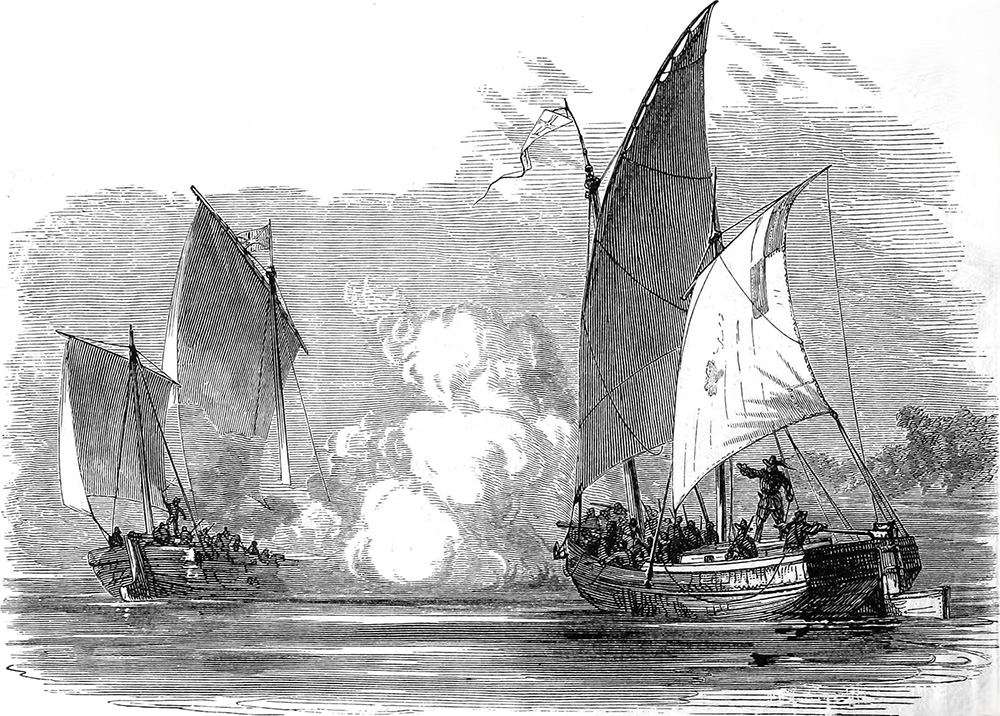
This illustration from an 1876 book of popular history shows Thomas Cornwallis's and William Claiborne's ships battling over Kent Island in 1635.
Thomas Cornwallis (c. 1605-1675/76)
Thomas Cornwallis was one of the first investors in the colony of Maryland and was one of its leading men. He was born into a noble Catholic family in England in 1605. Cornwallis was the second son in his family. In the time period in which Cornwallis lived, all of the father’s property would go to the first son upon the father’s death. As a second son, Thomas could not hope to inherit land in England, which prompted him to come to America. In 1634, he accompanied Governor Leonard Calvert on a voyage to Maryland as one of the original commissioners of the colony.
As commissioner, Cornwallis advised Governor Calvert about important matters. During the colony’s early years, Cornwallis served as captain and chief military officer. He led the soldiers in several battles, including a 1635 battle at Kent Island with William Claiborne and his men, who had been trading illegally. William Claiborne, who was from Virginia, resented that his lands had been included in the grant to Lord Baltimore and refused to listen to Maryland’s authority. In 1638, Cornwallis led an expedition that took control of Kent Island for the Calvert family.
Cornwallis combined his military power with economic success. He established the first mill in the colony and built a large framed house as an example to others.1 Although Cornwallis grew some tobacco, he earned most of his money by investing in the fur trade.
Like many merchant-planters in the colonies, Cornwallis served as a creditor to his poorer neighbors, lending money and then collecting interest. At one point in 1642, Cornwallis had debts due him for 40,056 pounds of tobacco, or about 664 pounds sterling.2 All of these activities helped make Cornwallis very wealthy. For nearly a decade, Cornwallis was known as the richest man in Maryland.3
Cornwallis lost much of his land and money when a Protestant named Richard Ingle began attacking Catholic settlements in St. Mary’s in 1644. Ultimately, Cornwallis returned to England, but his early role in Maryland as an investor and a political and military leader was important to the colony’s success.
2Land, A. C. (1981). Colonial Maryland: A history. KTO Press. p.29.
3Riordan, T. B. (1997). The plundering time: Maryland in the English Civil War, 1642–1650 [Unpublished manuscript].
« Back to Library Collection
Sources:
Carr, L. G., Menard, R. R., & Peddicord, L. (1984). Maryland... at the beginning. Hall of Records Commission, Department of General Services.
Land, A. C. (1981). Colonial Maryland: A history. KTO Press.
Maloney, E. J. (1996). Papists and Puritans in early Maryland: Religion in the forging of provincial
Riordan, T. B. (2004). The plundering time: Maryland in the English Civil War, 1645–1646. Maryland Center for History and Culture.
Papenfuse, E. C., [Author 2], [Author 3], ... (1979). A biographical dictionary of the Maryland legislature, 1635–1789 (Vols. 1–2). Johns Hopkins University Press.