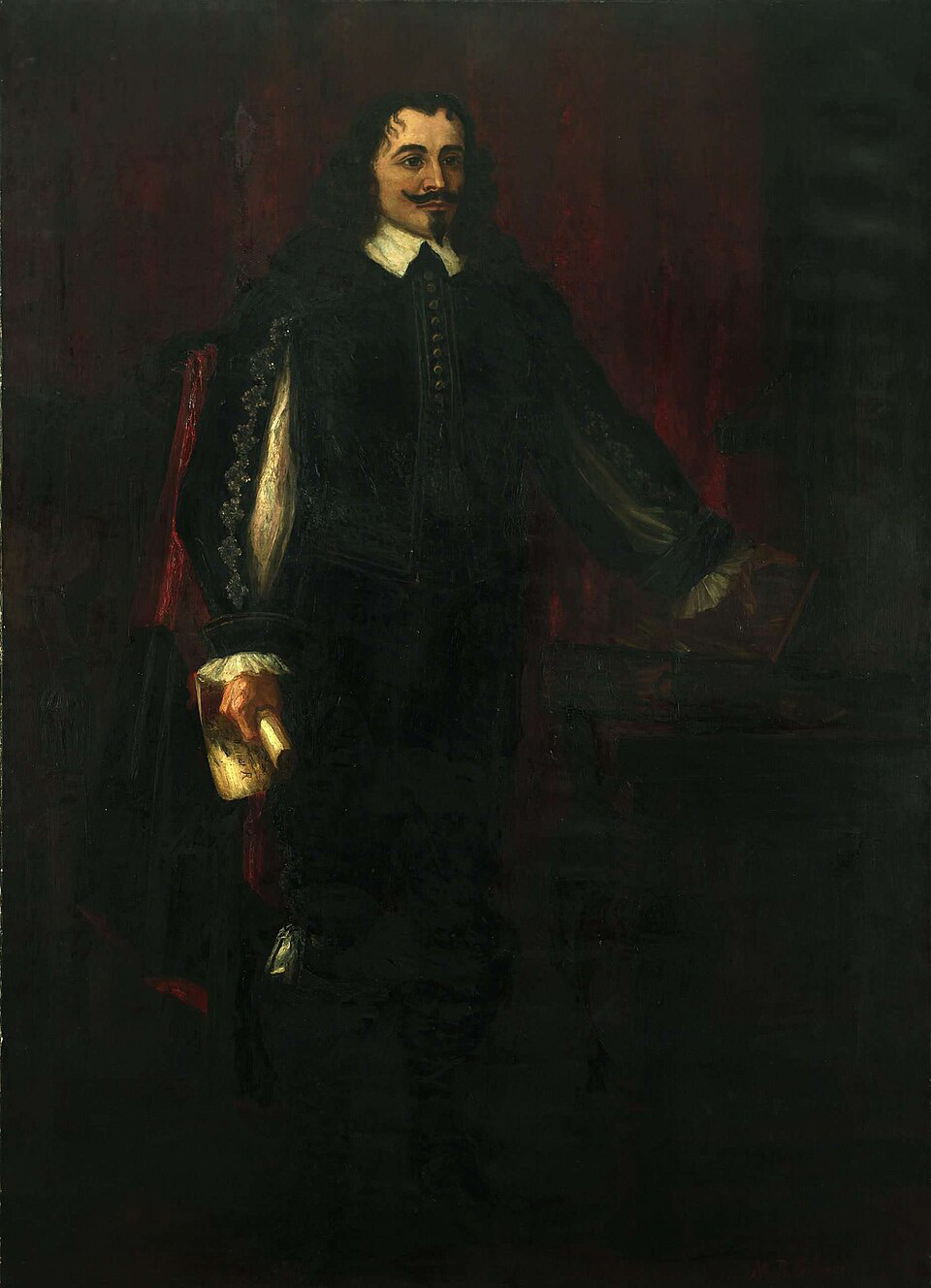
A painting of what William Claiborne may have looked like, painted by Mary Gilmer in 1907. This was a reproduction based on an earlier portrait.
William Claiborne (1600-c.1677)
William Claiborne was a member of the Virginia council. He established a trading post on Kent Island in the Chesapeake Bay just before King Charles I granted the colony of Maryland to Cecil Calvert, Lord Baltimore. Kent Island was the first English settlement in Maryland. Today, Claiborne is known for causing a lot of trouble for Virginia's neighbor, Maryland.
Claiborne was born in Kent, England, in 1600 and came to the colonies in 1621. He was educated and from a family with money and good social connections. At first he was a successful tobacco farmer, but he soon became interested in the Chesapeake fur trade. Claiborne developed good relations with the Susquehannock people, who provided him with beaver furs that could be sold for a profit in England. Claiborne established a profitable trading base on Kent Island, not knowing that King Charles I of England would soon grant this same land to Lord Baltimore. This led to major disagreement among Claiborne, Lord Baltimore, and Leonard Calvert.
When Leonard Calvert, the governor of Maryland, arrived in America to claim the colony’s territory, Claiborne refused to leave or to allow his land to become part of Maryland. Claiborne’s supporters fought briefly with Calvert's forces but Claiborne could not defeat them. Claiborne returned to England to argue his case before the king; however, while he was gone, Maryland gained control of Kent Island.
Soon afterward, the king agreed that the island belonged to Maryland. However, the battle for Kent Island did not end there. Several times during the 17th century, conflict arose between Protestants and Catholics in Maryland.
In 1645, the Protestant Richard Ingle led a rebellion. Ingle and his supporters attacked the Catholic settlers of Maryland. Claiborne, also a Protestant, joined forces with Ingle to regain control of Kent Island. Together, they forced Governor Calvert to flee to Virginia. However, Calvert returned the following year with paid soldiers from Virginia and defeated Ingle's troops. Maryland was back under the control of the Calverts, but not for long.
In 1651, William Claiborne was appointed to a commission. He was to go to Virginia and Maryland to make sure the colonies were loyal to the new English government. Claiborne and his partner, Richard Bennett, overthrew Maryland's government and took control of the colony for several years.
Kent Island once again belonged to Claiborne for a short while until Oliver Cromwell, a powerful leader and Lord Protector in England, returned the colony (including Kent Island) to the Calvert family. Claiborne hoped and fought to get Kent Island back for forty years, right up until his death.
Claiborne’s last attempt was peaceful but still unsuccessful. In 1677, he sent a petition to King Charles II asking for the return of the island, but he died without recovering what he truly believed was his land.
« Back to Library Collection
Sources:
Fausz, J. F. (1988). Merging and emerging worlds: Anglo-Indian interest groups and the development of the seventeenth-century Chesapeake. In L. G. Carr, P. D. Morgan, & J. B. Russo (Eds.), Colonial Chesapeake society (pp. XX–XX). University of North Carolina Press.
Fausz, J. F. (1984, Spring). Present at the "creation": The Chesapeake world that greeted the Maryland colonists. Maryland Historical Magazine, 79(1), 7–20.
Hale, N. C. (1951). Virginia venturer: A historical biography of William Claiborne, 1600–1677. The Dietz Press.
Hall, C. C. (Ed.). (1910). Narratives of early Maryland, 1633–1684. Barnes & Noble.
Isaac, E. (1957). Kent Island: Part I: The period of settlement. Maryland Historical Magazine, 52, 93–119.
Jester, A. L., & Hiden, M. W. (Eds.). (1956). Adventurers of purse and person: Virginia, 1607–1625. Princeton University Press.
Maloney, E. J. (1996). Papists and Puritans in early Maryland: Religion in the forging of provincial society, 1632–1665 [Doctoral dissertation, State University of New York at Stony Brook].
Papenfuse, E. C., et. al. (1979). A biographical dictionary of the Maryland legislature, 1635–1789 (Vols. 1–2). Johns Hopkins University Press.