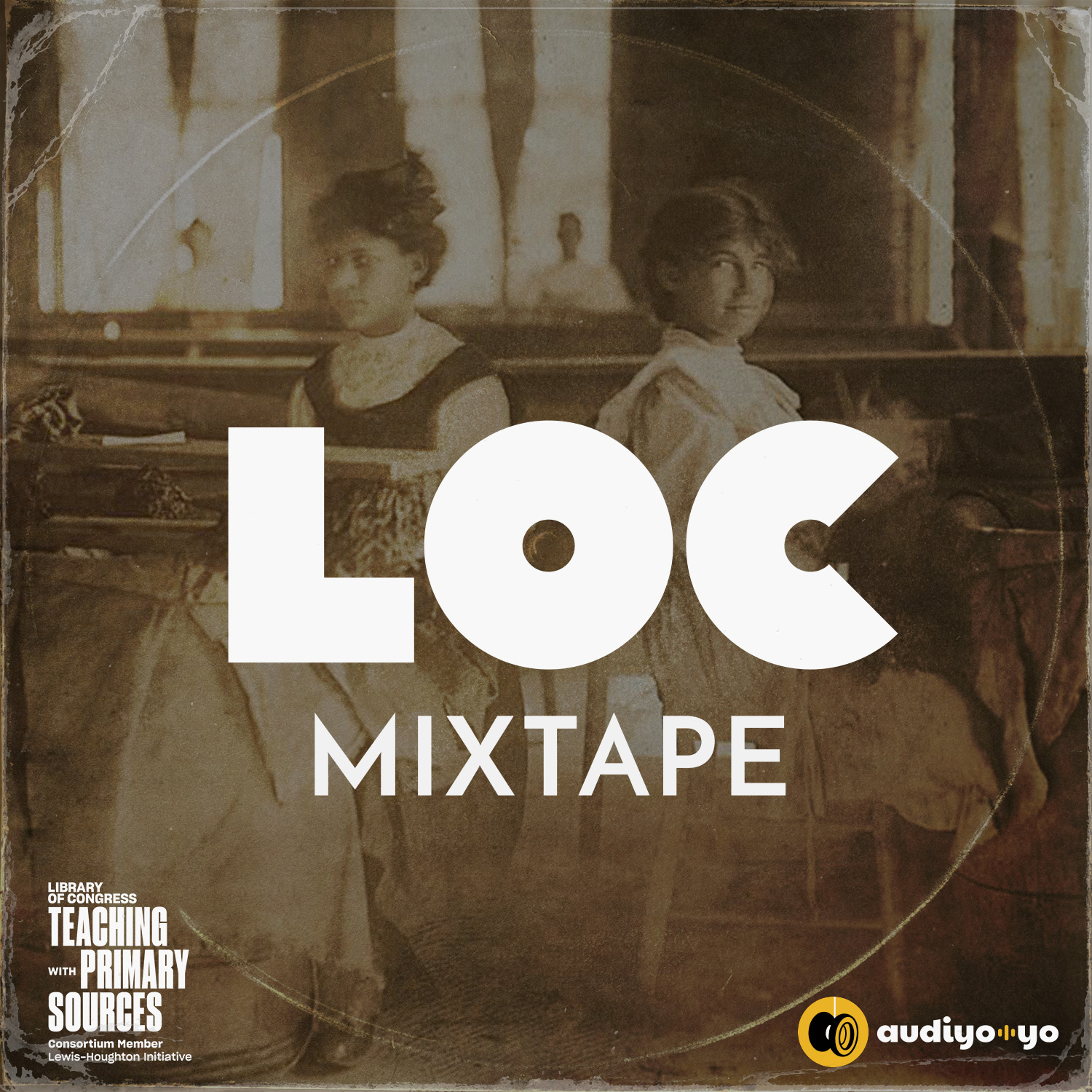
“Señora Santana”
Grades 9-12
Teacher’s Guide and Related Standards
This lesson explores the significance of children’s music through the 1939 recording of the folk song “Señora Santana” sung by Adelpha Pollato. Students will have the opportunity to 1) learn about the historical context of the WPA recordings process, 2) listen to and analyze the lyrics of “Señora Santana,” and 3) participate in creative activities connected to children’s songs as expressions of memory and identity.
Discover how LOC Mixtape introduces listeners to musical primary sources and invites artists to reimagine the music in new ways using the Five “M’s” of Music as a Primary Source.
» Go to LOC Mixtape: Exploring Musical Primary Sources
Standards
- National Association for Music Educators (NAfME) Standards (Theory and Composition Strand; Guitar/ Keyboard/ Harmonizing Instruments; Ensembles)
- Common Anchor Standard 1
- This standard focuses on creating music based on experiences and context.
- Common Anchor Standard 4
- Common Anchor Standard 7
- This standard especially applies to the curated collection exercise. It asks students to choose music for specific contexts and purposes.
- Common Anchor Standard 11
- This standard relates to the overall engagement with the podcast and accompanying exercises: It encourages students to explore how other disciplines, experiences, and daily life inform the creation of music
- Dimension 2: Applying disciplinary concepts and tools
- History
- Change, Continuity, and Context
- Perspectives
- Historical Sources and Evidence
Procedure
Introduction
This lesson on lullabies is designed to accompany the LOC Mixtape Podcast, Episode 2. The thinking and active listening questions are designed to encourage students to engage with the podcast episode, while the supplementary activities can be used to spark creative interaction based on the ideas presented in the podcast.Podcast Episode Guide
This guide helps teachers understand the structure of the podcast episode and plan classroom discussions or activities. Use the timestamps to navigate the episode and highlight key segments.Episode Format Overview:
- 0:00 – 1:04 | Host introduction
The host introduces the show’s theme of exploring audio primary sources from the Library of Congress and doing “remixes” of them, providing context and modeling how a podcast engages listeners from the start. - 1:04 – 2:34 | Episode topic introduction
The episode’s focus is introduced. Students can note the topic and reflect on their prior knowledge or any questions they may have. - 2:34 - 4:53 | “Imagine This” segment
Primary source audio is played along with accompanying descriptive narration, helping students visualize its historical or cultural context. The host tees up the guest expert(s), bridging the source and expert insight. - 4:53 – 17:53 | Historical expert interview
The guest expert discusses the topic in depth with the host. Encourage students to listen for evidence, examples, and explanations that connect to the primary source audio. - 17:53 – 19:04 | Transition to musical guest
Another audio clip introduces a new perspective and sets up the musician interview. Teachers can prompt students to compare and contrast with earlier sources. - 19:04 – 38:58 | Musician interview
The guest musician shares their response to the primary source and how they created a new work in conversation with that source. This segment illustrates how primary sources and personal experiences inform our understanding of cultural history and can inspire new creative endeavors. - 38:58 – 39:57 | Original remix audio
Students hear a creative reinterpretation of the primary source. This segment can be used to discuss adaptation, creativity, and the evolution of cultural practices. - 39:57 – End | Outro and credits
The host wraps up the episode. Teachers can guide students to reflect on what they learned and connect it to broader themes, related questions, extension/enrichment activities, or classroom projects.
- 0:00 – 1:04 | Host introduction
Extension
Additional exploration of this topic could involve exploring the more recent circulation of “Señora Santana recordings,” which can be found on the internet. The objective is to have students explore how families and communities share the song with the young people in their lives.
Exercise: Using a device with an internet connection, have students consider:
- How many versions of the song can you easily find online?
- Do any of the versions that you found sound similar to the Ybor City recording?
- Which artists, community members, students, or other groups made recordings of “Señora Santana?”
- Why do you think the song remains relevant in communities and families today?
Assessment
Depending on instructional choices and class priorities, a variety of interdisciplinary learning outcomes might be measured through a customized rubric. Measurable learning outcomes might include:
- Accurate musical or historical analysis
- Lyrical or musical inventiveness
- Synthesis of historical and musical context
- Demonstration of musical elements (rhythm, form, melody, etc.)
- Thematic insights through students' personal reflections
Feel free to use the rubric below or create one that measures the specific learning outcomes that you have identified.
Summative Assessment Rubric (writing or oral exercise)
| No Response Score Point 0 |
Not There Yet Score Point 0.5 |
Beginning To Score Point 0.75 |
Yes Score Point 1.0 |
|---|---|---|---|
| The claim is missing. | The claim is incorrect or irrelevant. | The claim partially takes a position on the topic or issue addressed within the prompt. | The claim takes an appropriate position on the topic or issue addressed within the prompt. |
| There is no type of evidence in the response. | The evidence is irrelevant or does not support the claim. | The evidence partially supports the claim and demonstrates some understanding of the topic or text, using appropriate sources. | The evidence supports the claim and demonstrates a strong understanding of the topic or text, using appropriate sources. |
| There is no use of words, phrases, and clauses to create cohesion and to clarify the relationship between the claim and evidence. | Use of words, phrases and clauses fail to show or explain any relationship between the claim and evidence. | Words, phrases, and clauses used lack cohesion but partially clarify the relationship between the claim and evidence. | Appropriate words, phrases, and clauses are used to create cohesion and to clarify the relationship between the claim and evidence. |
Teacher Resources
An Educator's Guide to Using Music as a Primary Source in the History Classroom - This teacher guide explains the TeachRock framework for exploring history through music-based primary sources. The framework focuses on five areas of analysis: musicians, media, materials, mapping, and music making.
Audio recordings | Library of Congress - Search the Library of Congress collections for other versions of “Señora Santana.”
“Caught My Ear: The Lullaby That Came to Symbolize the Exodus of Cuba’s Children” - This blog post from the Library of Congress explores how the traditional Spanish-language lullaby “Señora Santana” evolved in Cuban and Cuban-American communities to become a symbol of childhood exile and loss tied to Operación Pedro Pan, or Operation Pedro Pan.
“Caught My Eye: Intern Edition!”room - This Library of Congress podcast explores different versions of “Señora Santana.” Start the recording at 12:40 for the discussion of the song.
Ybor City Historic District Tampa FL - This National Park Service webpage highlights Tampa’s National Historic Landmark neighborhood, which was once the thriving “Cigar Capital of the World,” known for its 950 historic buildings and rich multicultural immigrant heritage.
References
Hall, S. (2018, September 17). Songs from Cuban Americans in Florida, 1939-1940. Folklife Today. Library of Congress.
https://blogs.loc.gov/folklife/2018/09/songs-from-cuban-americans-in-florida-1939-1940/
Kennedy, S. (n.d.). A Florida treasure hunt. Library of Congress.
https://www.loc.gov/collections/florida-folklife-from-the-works-progress-administration/articles-and-essays/a-florida-treasure-hunt/