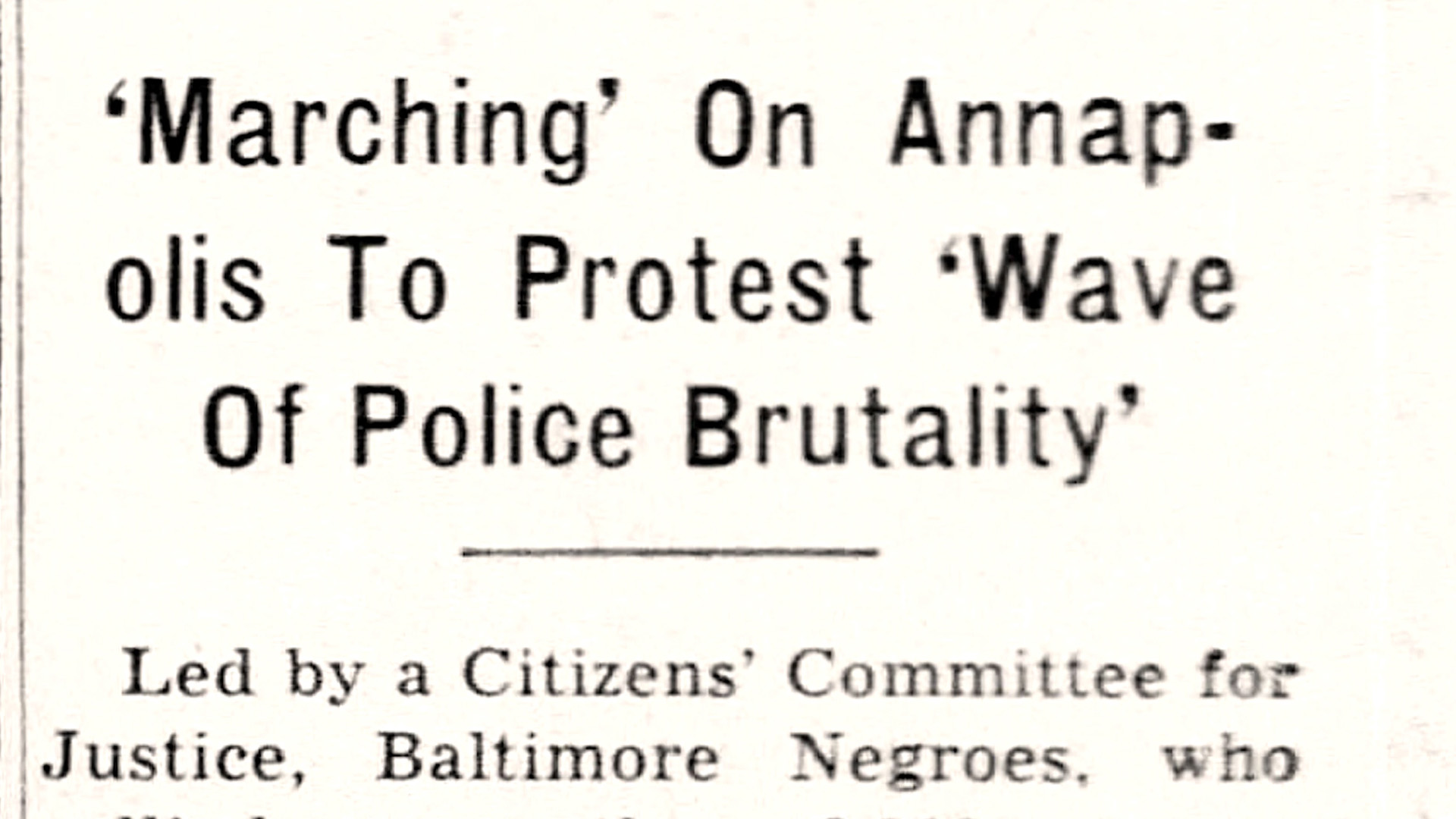
The 1942 March on Annapolis mobilized Black Marylanders in a nonviolent demonstration at the Maryland State House, bringing attention to civil rights and police accountability.
The March on Annapolis (1942)
Grade 9-12
On April 24, 1942, the March on Annapolis was held in response to the fatal shooting of Private Thomas E. Broadus by a Baltimore City police officer. Following his death, more than 2,000 demonstrators marched to the Maryland State House to protest police brutality and demand accountability. In response to the protest and the concerns raised, Maryland’s Governor Herbert O'Conor agreed to establish a commission to investigate the issues and recommend reforms.
In this lesson, students examine the 1942 March on Annapolis to learn how nonviolent protest and Black-owned media mobilized citizens against police brutality, helping Black Marylanders build influence to demand police accountability and press state leaders for institutional change.
Teacher's Guide and Related Standards
Students will analyze the significance of the March on Annapolis (1942).
- What events and concerns led community members and activists to organize the March on Annapolis in 1942?
- How did the March on Annapolis connect to the overarching goals, strategies, and tactics of the African American Civil Rights Movement?
- To what degree do issues of police accountability and civil rights activism continue to impact Maryland society today?
Video Clip
- The Baltimore Afro-American newspaper was established in 1892 and served as a key source of news for African Americans. In 1942, the paper closely followed events related to Broadus' killing.
- How did Black-owned media, such as the Baltimore Afro-American, help shape public awareness and mobilize citizens for the march?
- How did nonviolent demonstrations in the 1940s signal a shift in political leverage and voter impact among Black Marylanders?
- How does the March on Annapolis connect to or parallel broader African American civil rights activism during the early 20th century?
Vocabulary
Supplemental Enrichment Activities
Examining Marchers' Demands
The Baltimore Afro-American Newspaper was established in 1892 and served as a key source of news for African Americans. In 1942, the paper closely followed the events related to Broadus’s killing.
Provide students with a primary source analysis worksheet to analyze the goals the march outlined in the April 18, 1942, article "What Citizens’ Group is Seeking in Its March on Annapolis." Have them create a brochure explaining these demands and summarizing the events surrounding Private Thomas E. Broadus' death.
Use this Library of Congress teacher guide to help students analyze the primary source.
Exploring Nonviolent Resistance
The marchers who brought their demands to Annapolis in 1942 demonstrated nonviolent resistance, which also played a pivotal role in the Long Civil Rights Movement that began in the late 1930s.
Using a graphic organizer, students will create an annotated timeline with five examples of nonviolent resistance used to expand Americans' rights and privileges. The Jim Crow Museum: Civil Rights Era website is a helpful resource for students discovering key events.
Connecting Past and Present
In April 2015, a Black man named Freddie Gray was arrested in Baltimore and taken on a “rough ride” in a police van. He died of spinal cord injuries a week later.
In Professor Yohuru Williams’ editorial later that month, he drew connections between the response to Broadus’ killing at the hands of police in 1942 and the response to Gray’s killing in 2015. The author says, “History does not repeat itself ... What it does is reflect.”
Provide students with this worksheet to organize their thoughts in response to the following prompts: (1) In what ways does Freddie Gray’s killing reflect Thomas Broadus’? (2) How are those deaths reflected in the broader context of American history? (3) How do the two situations differ?