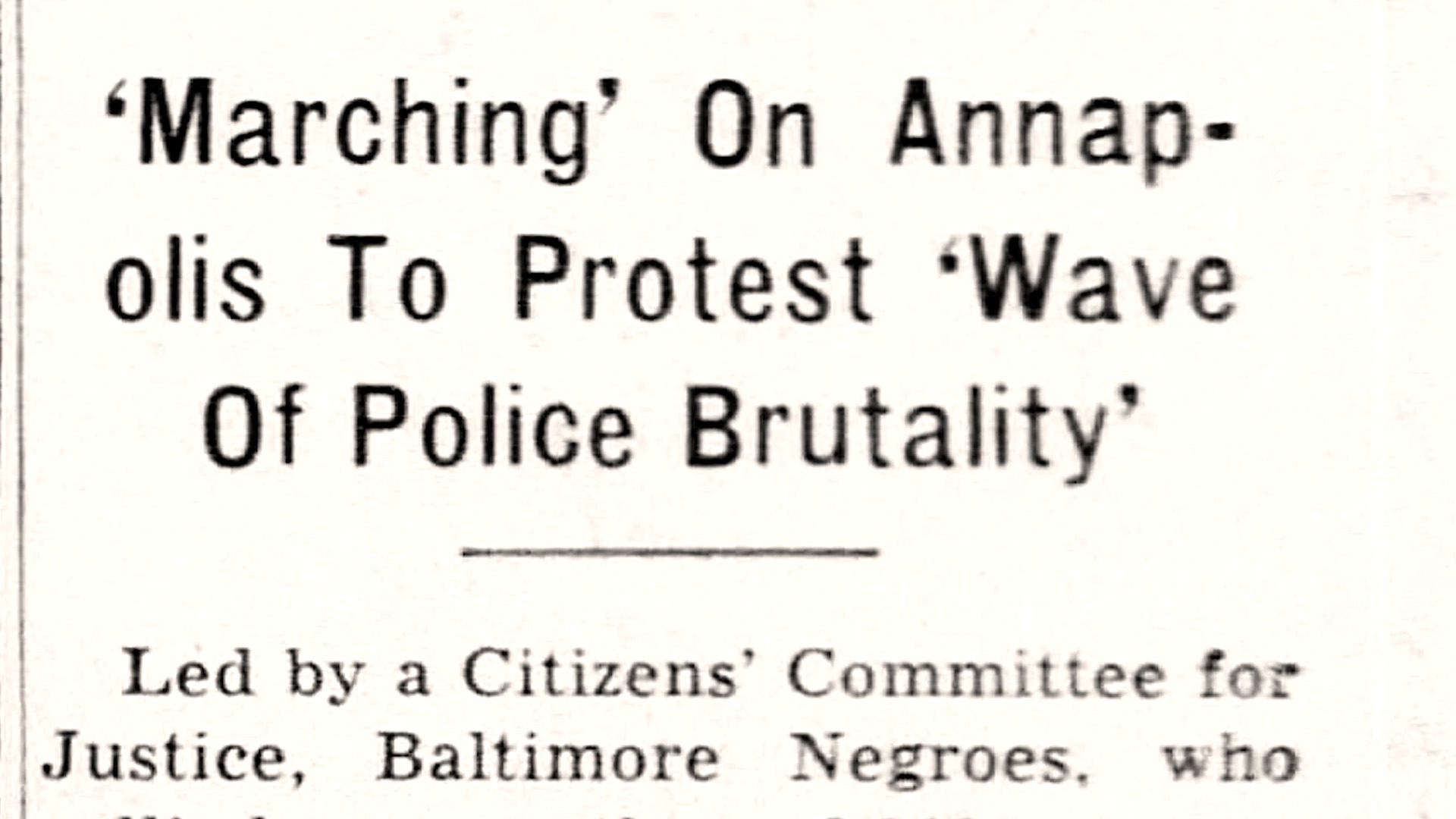
The 1942 March on Annapolis mobilized Black Marylanders in a nonviolent demonstration at the Maryland State House, bringing attention to civil rights and police accountability.
The March on Annapolis (1942)
Grade 9-12
Teacher’s Guide and Related Standards
In this lesson, students examine the 1942 March on Annapolis and analyze how nonviolent resistance and Black-owned journalism mobilized over 2,000 demonstrators to protest police brutality at the Maryland State House. They also explore how this pivotal event in Maryland history connected to the broader American Civil Rights Movement and evaluate its lasting impact on political leverage, nonviolent protest, and contemporary issues of police accountability.
Procedure
Students will examine the causes, tactics, and impact of the 1942 March on Annapolis through video analysis, class discussions, and historical inquiry. Their task will be to analyze how Black Marylanders used newspaper media and nonviolent demonstration to mobilize and to demand police accountability at the state capital. Final reflection prompts on civic engagement, political leverage, and parallels to modern civil rights activism are also included.
INTRODUCTION (20 minutes)
- To connect to prior learning, teachers may ask students to recall what they already know about civil disobedience and nonviolent resistance.
- Explain that students will be learning about the March on Annapolis (1942). Play the video clip.
- As a class, discuss the lesson’s essential questions and thinking questions via a whole-group discussion or Think-Pair-Share format.
EXTENSION (20-40 minutes)
Complete the supplemental extension activities with students, as you see fit.
SUMMATIVE ASSESSMENT (30-40 minutes)
- Have students apply their newfound knowledge by completing a summative Claim, Evidence, Reasoning (CER) on the lesson using evidence from the lesson as support.
- Option 1: Use evidence and information from the lesson video and activity resources to explain the goals of the activists who organized the March on Annapolis.
- Option 2: Develop a claim regarding the effectiveness of civil disobedience as a method to enact change.
- Students can use the sources in the "Research Support" section to investigate the topic.
- To support their claim, students should use evidence and reasoning from the A Nation Begins: The Maryland State House at 250 video clip and activities.
- Refer to the following rubric.
REFLECTION (10 minutes)
Have students complete a reflection in response to the following questions.
- What strategies and tactics did African Americans use to expand their rights in the 20th century?
- Why is it important to learn about civil rights activism that occurred before the 1950s?
Standards
Maryland Social Studies Standards
Standard 6.0: Skills and Processes
- Students will inquire about civics, geography, economics, history, and people and nations of the world using disciplinary literacy skills and processes to critically evaluate content through a variety of source materials across disciplines and use reading, writing, and other forms of communication to develop, defend, and critique arguments in order to take informed action.
High School American Government Studies Standards
- GOV.2.2 The student will explain roles and analyze strategies individuals or groups may use to initiate change in governmental policy and institutions by:
- Analyzing various methods that individuals or groups may use to influence laws, government policies, and elections including referendum, acts of civil disobedience, voting, boycotts, financial contributions, digital communication, and voting drives. (GOV.2.2.c)
High School United States History Standards
- USH.3.3 Students will analyze how individuals and groups mobilized against inequalities in American society by:
- Evaluating the tools, methods, and leadership utilized by the African American Civil Rights Movement to challenge unequal access to economic opportunity, public accommodations, and political participation. (USH.3.3.b)
- D2.His.3.9-12. Use questions generated about individuals and groups to assess how the significance of their actions changes over time and is shaped by the historical context.
- D2.His.5.9-12. Analyze how historical contexts shaped and continue to shape people’s perspectives.
- D2.His.14.9-12. Analyze multiple and complex causes and effects of events in the past.
Reflection Questions
- What strategies and tactics did African Americans use to expand their rights in the 20th century?
- Why is it important to learn about civil rights activism that occurred before the 1950s?
Summative CER
Option 1: Use evidence and information from the lesson video and activity resources to explain the goals of the activists who organized the March on Annapolis.
Option 2: Develop a claim regarding the effectiveness of civil disobedience as a method to enact change.
CER Rubric (Total: 9 Points)
| 3 Points | 2 Points | 1 Point | 0 Points | |
|---|---|---|---|---|
| Claim | The student clearly answered the question chosen. The claim fully addresses the topic. | The student answered the question, but the claim may be somewhat unclear or incomplete. | The claim is unclear, too general, or does not fully answer the question. | No claim |
| Evidence | The student used specific, accurate facts from the lesson activities. | The student used some evidence, but it may be general, lack detail, or need more explanation. | The student gave limited, weak, or unclear evidence. | No evidence |
| Reasoning | The student clearly explained how the evidence supports the claim. | The student explained their thinking, but the connection between the evidence and the claim is not fully clear. | The student’s reasoning was unclear, incomplete, and largely repeated the evidence. | No evidence |
Research Support
Baltimore: A White Cop Killed a Black Serviceman in Baltimore in 1942. The Investigative Files Have Just Been Released.
This magazine article examines the newly released investigative files regarding the 1942 killing of a Black serviceman by a white Baltimore police officer.
Center for Nonviolent Conflict Research: The US Civil Rights Movement (1942-1968)
This research guide explores the history and strategic role of nonviolent action during the U.S. Civil Rights Movement.
Civil Rights Cold Case Records Review Board: Thomas Edward Broadus
This official government website provides access to declassified records and files pertaining to civil rights-era cold cases.
JSTOR Daily: The Long Civil Rights Movement
This digital magazine article analyzes the historiographical concept of the "long" civil rights movement and its broader chronological scope..
Maryland Center for History and Culture: Judge Harry Cole Interview
This oral history resource features an interview discussing the life, career, and legal contributions of trailblazing Maryland judge Harry Cole.
References
PBS, A Nation Begins: The Maryland State House at 250 - A film clip from A Nation Begins: The Maryland State House at 250 was used in this lesson. Continue to watch the full documentary to learn about the oldest state capitol in continuous legislative use—and the only one to ever serve as the capital of the United States.