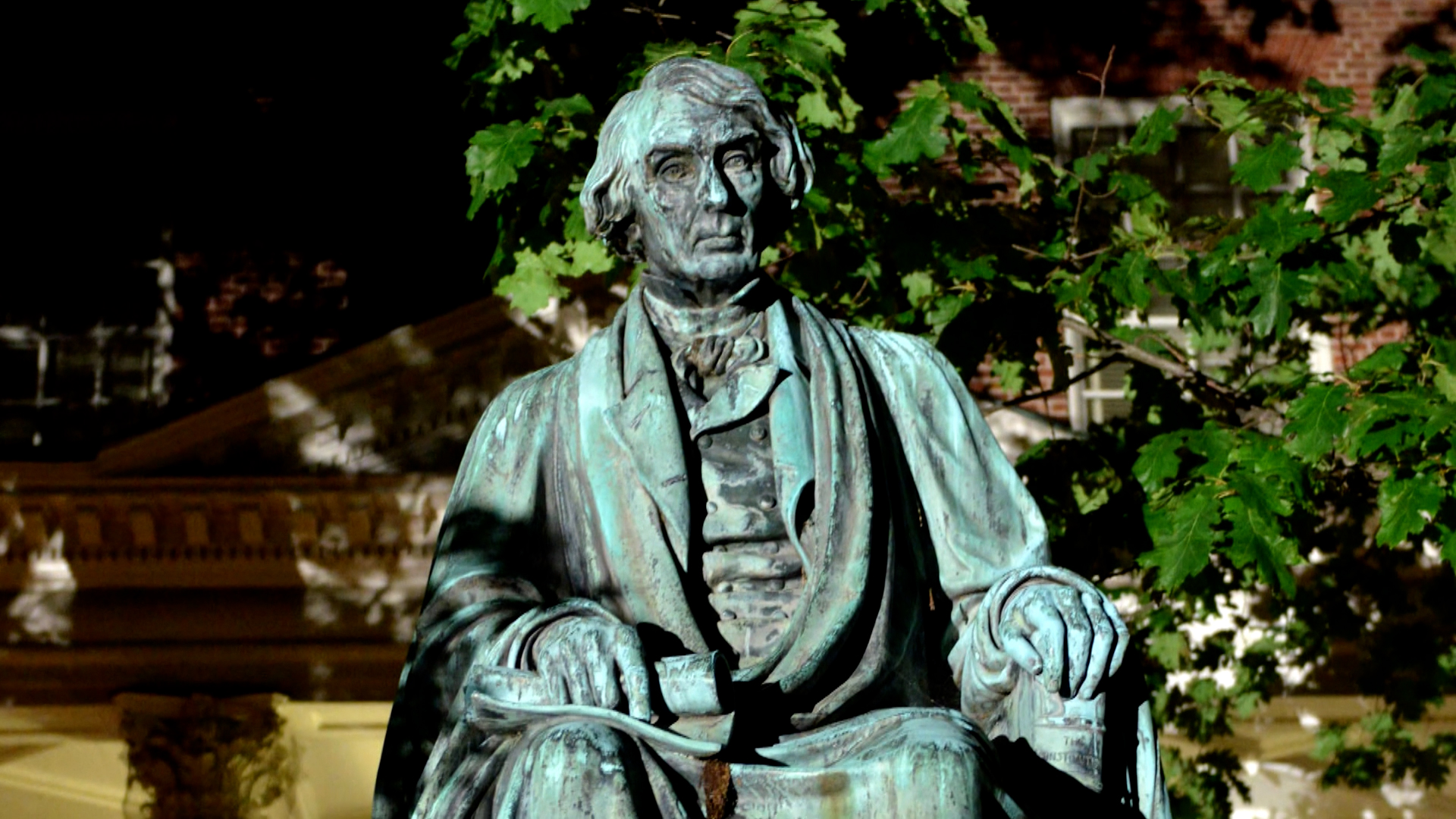
The statue of former Supreme Court Chief Justice Roger B. Taney was removed from the Maryland State House in August 2017, ending its 145-year presence outside the capital building.
Roger Taney’s Legacy
Grade 9-12
Teacher’s Guide and Related Standards
In this lesson, students examine Supreme Court Chief Justice Roger B. Taney’s landmark Dred Scott v. Sandford decision and analyze how the 2017 removal of his statue from the Maryland State House reflects evolving views on citizenship and historical legacy. They also explore how public monuments shape collective memory and consider how societies decide which historical figures to honor.
Procedure
Students will investigate the complex legacy of Chief Justice Roger B. Taney and his 1857 Dred Scott v. Sandford ruling through video analysis, text readings, and historical inquiry. Their task will be to create a brief constructed response using lesson resources to evaluate the impact of Taney’s legal decisions and the debate surrounding the 2017 removal of his statue from the Maryland State House. Final reflection prompts on public monuments and the importance of studying controversial historical figures are also included.
INTRODUCTION (20 minutes)
- To connect to prior learning, teachers may ask students to recall what they already know about the state of the union in the 1850s. Students should consider the growing sectional divides and debates over slavery.
- Explain that students will be learning about the impact of the Dred Scott decision (1857) and the controversy over Roger Taney’s statue, previously on display at the Maryland State House. Play the video clip.
- As a class, discuss the lesson’s essential questions and thinking questions via a whole-group discussion or Think-Pair-Share format.
EXTENSION (20-40 minutes)
Complete the supplemental extension activities with students, as you see fit.
SUMMATIVE ASSESSMENT (30-40 minutes)
- Have students apply their newfound knowledge by completing a summative Claim, Evidence, Reasoning (CER) on the lesson using evidence from the lesson as support.
- Option 1: Use evidence and information from the lesson video and activity resources to describe the impact of Dred Scott v. Sandford (1857) on American society.
- Option 2: Develop a claim regarding the appropriateness of removing Roger Taney’s statue from the Maryland State House in 2017.
- Students can use the sources in the "Research Support" section to investigate the topic.
- To support their claim, students should use evidence and reasoning from the A Nation Begins: The Maryland State House at 250 video clip and activities.
- Refer to the following rubric.
REFLECTION (10 minutes)
Have students complete a reflection in response to the following questions.
- What is the legacy of the Dred Scott decision today?
- Why is it important to study controversial figures in American history?
Standards
Maryland Social Studies Standards
Standard 6.0: Skills and Processes
- Students will inquire about civics, geography, economics, history, and people and nations of the world using disciplinary literacy skills and processes to critically evaluate content through a variety of source materials across disciplines and use reading, writing, and other forms of communication to develop, defend, and critique arguments in order to take informed action.
Middle School United States History Framework
- 8.5.6 Students will evaluate the causes of the Civil War by:
- Evaluating the impact of territorial expansion, the Supreme Court, and individual action on sectional polarization. (8.5.6.a)
- D2.His.3.9-12. Use questions generated about individuals and groups to assess how the significance of their actions changes over time and is shaped by the historical context.
- D2.His.11.9-12. Critique the usefulness of historical sources for a specific historical inquiry based on their maker, date, place of origin, intended audience, and purpose.
- D2.His.7.9-12. Explain how the perspectives of people in the present shape interpretations of the past.
CER Rubric (Total: 9 Points)
| 3 Points | 2 Points | 1 Point | 0 Points | |
|---|---|---|---|---|
| Claim | The student clearly answered the question chosen. The claim fully addresses the topic. | The student answered the question, but the claim may be somewhat unclear or incomplete. | The claim is unclear, too general, or does not fully answer the question. | No claim |
| Evidence | The student used specific, accurate facts from the lesson activities. | The student used some evidence, but it may be general, lack detail, or need more explanation. | The student gave limited, weak, or unclear evidence. | No evidence |
| Reasoning | The student clearly explained how the evidence supports the claim. | The student explained their thinking, but the connection between the evidence and the claim is not fully clear. | The student’s reasoning was unclear, incomplete, and largely repeated the evidence. | No evidence |
Standards
Maryland Social Studies Standards
Standard 6.0: Skills and Processes
- Students will inquire about civics, geography, economics, history, and people and nations of the world using disciplinary literacy skills and processes to critically evaluate content through a variety of source materials across disciplines and use reading, writing, and other forms of communication to develop, defend, and critique arguments in order to take informed action.
Middle School United States History Framework
- 8.5.6 Students will evaluate the causes of the Civil War by:
- Evaluating the impact of territorial expansion, the Supreme Court, and individual action on sectional polarization. (8.5.6.a)
- D2.His.3.9-12. Use questions generated about individuals and groups to assess how the significance of their actions changes over time and is shaped by the historical context.
- D2.His.11.9-12. Critique the usefulness of historical sources for a specific historical inquiry based on their maker, date, place of origin, intended audience, and purpose.
- D2.His.7.9-12. Explain how the perspectives of people in the present shape interpretations of the past.
Research Support
American Battlefield Trust: Roger B. Taney
This biography details the life and legal career of Chief Justice Roger B. Taney, focusing on his authorship of the Dred Scott decision.
Bill of Rights Institute: Should Controversial Historical Statues be Taken Down?
This debate resource presents arguments surrounding the removal of public statues of controversial historical figures.
Britannica: Historic Statue Removal
This reference article explores the pros and cons of removing historical statues and monuments.
Landmark Cases: Scott v. Sandford (1857)
This educational case overview outlines the background, arguments, and decision of Dred Scott v. Sandford.
National Archives: Dred Scott v. Sandford (1857)
This milestone document guide provides historical context and primary source material from the landmark Dred Scott case.
National Constitution Center: Dred Scott v. Sandford (1857)
This constitutional case summary analyzes the Supreme Court ruling in Dred Scott v. Sandford and its impact on American history.
The National Judicial College: Roger B. Taney: One Decision Makes a Legacy, Part II
This judicial essay reflects on how Chief Justice Roger B. Taney's decision in the Dred Scott case defined his judicial legacy.
National Museum of African American History & Culture: The Human Factor of History: Dred Scott and Roger B. Taney
This museum article examines the personal lives and historical choices of Dred Scott and Chief Justice Roger B. Taney.
Northern Illinois University Center for Innovative Teaching and Learning: Classroom Debates
This instructional guide provides strategies and best practices for organizing and facilitating effective classroom debates.
References
PBS, A Nation Begins: The Maryland State House at 250 - A film clip from A Nation Begins: The Maryland State House at 250 was used in this lesson. Continue to watch the full documentary to learn about the oldest state capitol in continuous legislative use—and the only one to ever serve as the capital of the United States.