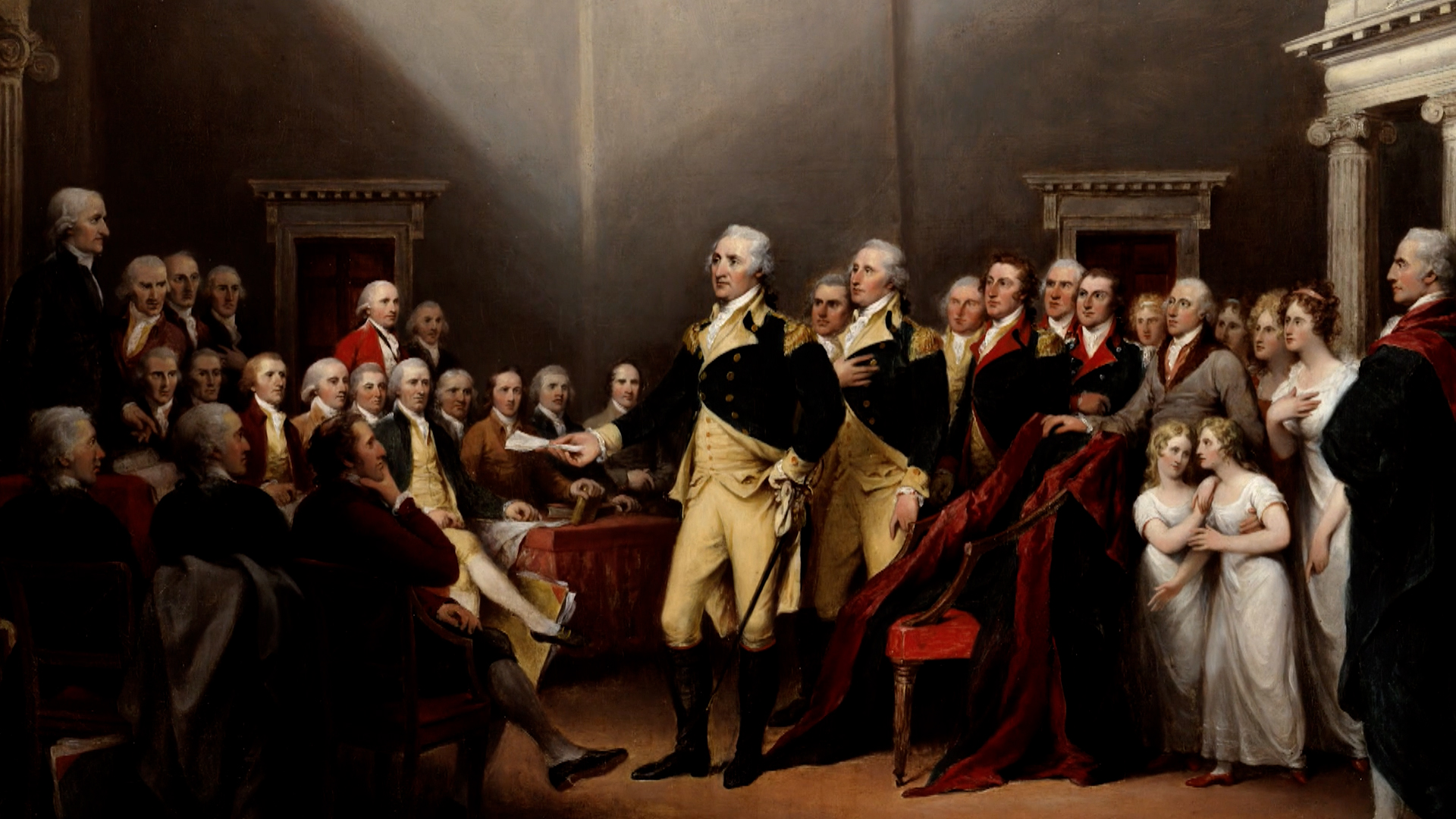
The Maryland State House was the site of George Washington’s 1783 resignation as commander-in-chief of the Continental Army, where he voluntarily surrendered military authority to the civilian government.
Washington Resigns His Military Commission
Grade 9-12
On December 23, 1783, George Washington resigned as commander-in-chief of the Continental Army at the Maryland State House in Annapolis. His decision to return to his home at Mount Vernon was a defining moment in American history. Although he could have used his military success to seize political power, Washington instead voluntarily returned authority to the Second Continental Congress. His resignation became a powerful symbol of civilian government and the principle that political power in the United States ultimately belongs to the people.
In this lesson, students will examine George Washington’s 1783 resignation as commander-in-chief of the Continental Army to learn how his decision established the principle of civilian control of government and set a foundational precedent for American democracy.
Teacher's Guide and Related Standards
Students will be able to describe the significance of George Washington’s decision to resign as commander of the Continental Army in 1783.
- What actions did George Washington take as commander-in-chief of the Continental Army?
- How did George Washington’s resignation as commander-in-chief establish the principle of civilian control of government in the United States?
Video Clip
- Why is the peaceful transfer of power important in a democratic society?
- Why might European rulers, including King George II of Britain, have been surprised by George Washington’s decision to resign?
- How did Washington’s decision to resign reflect the founding principles of the United States government?
Vocabulary
Supplemental Enrichment Activities
Analyzing Washington’s Resignation Speech
Students will conduct a primary source analysis of Washington’s resignation speech . Students will identify the speech’s message as well as the document’s historical context, intended audience, purpose, and point of view. This activity will allow students to historical thinking skills, such as contextualization and sourcing.
Provide students with this primary source analysis worksheet as an optional way for them to record their ideas and evidence while analyzing the speech.
Uncovering the Life of William “Billy” Lee
William “Billy” Lee served as George Washington’s valet, or personal attendant, for twenty years. Students will read about Lee on the George Washington’s Mount Vernon website to learn more about his role in the war and connection to Washington.
After reading the article, students will write a brief constructed response to the following prompts: (1) Describe the role William “Billy” Lee played in the American Revolution. (2) Justify why it is important to tell the stories of enslaved Americans. Use specific details and historical examples in your response.
Designing a Historical Plaque
John Trumbull’s painting, General George Washington Resigning His Commission, hangs in the Rotunda of the U.S. Capitol in Washington, D.C.
Students can view the painting and read about its significance on the Architect of the Capitol website . Afterwards, they will examine the artwork and design a descriptive plaque highlighting its historical context and significance.