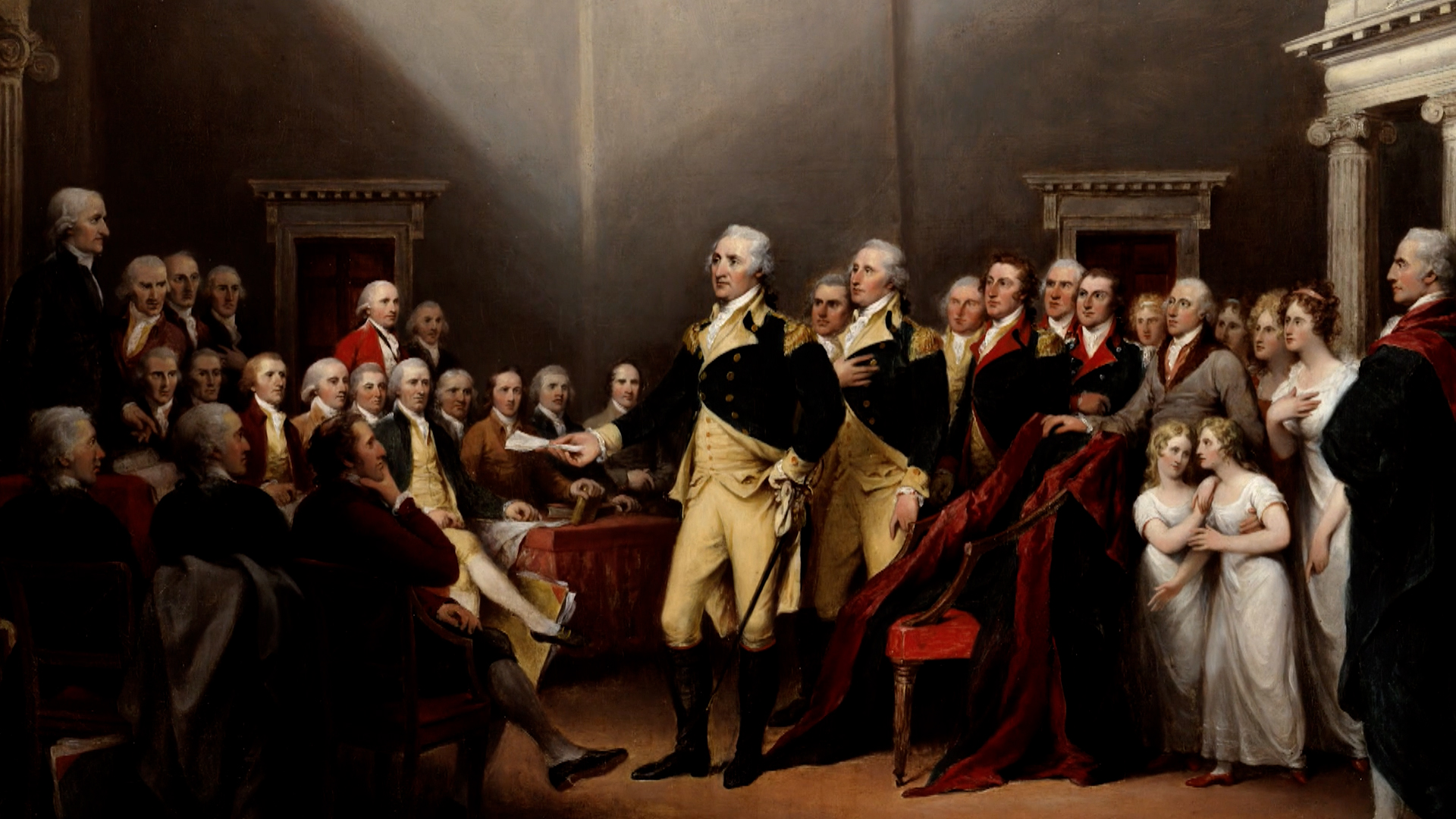
The Maryland State House was the site of George Washington’s 1783 resignation as commander-in-chief of the Continental Army, where he voluntarily surrendered military authority to the civilian government.
Washington Resigns His Military Commission
Grade 9-12
Teacher’s Guide and Related Standards
In this lesson, students examine George Washington’s 1783 resignation as commander-in-chief of the Continental Army and analyze how his decision at the Maryland State House established the principle of civilian control of government. They also explore how Washington’s voluntary surrender of military authority set a foundational precedent for the peaceful transfer of power in American democracy.
Procedure
Students will explore how George Washington’s 1783 resignation established civilian control of government through class discussions, video analysis, and Think-Pair-Share activities. Their task will be to create a Claim, Evidence, Reasoning (CER) response using lesson resources to evaluate the significance of Washington’s decision to step down as commander-in-chief. Final reflection prompts on popular sovereignty and the lasting importance of Washington’s precedent are also included.
INTRODUCTION (20 minutes)
- To connect to prior learning, teachers may ask students to recall what they already know about the Second Continental Congress and its role in the Revolutionary War.
- Explain that students will be learning about Washington’s decision to resign his role as commander-in-chief of the Continental Army in 1783. Play the video clip.
- Watch the video clip with students. Have students respond to the following Thinking Questions in a Think-Pair-Share format:
- Why is the peaceful transfer of power important in a democratic society?
- Why might European rulers, including King George II of Britain, have been surprised by George Washington’s decision to resign?
- How did Washington’s decision to resign reflect the founding principles of the United States government?
EXTENSION (20-40 minutes)
Complete the supplemental extension activities with students, as you see fit.
SUMMATIVE ASSESSMENT (30-40 minutes)
- Option 1: Use evidence and information from the video and activity resources to describe Washington’s role as commander-in-chief of the Continental Army.
- Develop a claim regarding the significance of Washington’s decision to resign as commander-in-chief of the Continental Army.
REFLECTION (10 minutes)
Have students complete a reflection in response to the following questions.
- How did Washington’s actions uphold the principle of popular sovereignty?
- Why is it important to learn about Washington’s resignation in 1783?
CER Rubric (Total: 9 Points)
| 3 Points | 2 Points | 1 Point | 0 Points | |
|---|---|---|---|---|
| Claim | The student clearly answered the question chosen. The claim fully addresses the topic. | The student answered the question, but the claim may be somewhat unclear or incomplete. | The claim is unclear, too general, or does not fully answer the question. | No claim |
| Evidence | The student used specific, accurate facts from the lesson activities. | The student used some evidence, but it may be general, lack detail, or need more explanation. | The student gave limited, weak, or unclear evidence. | No evidence |
| Reasoning | The student clearly explained how the evidence supports the claim. | The student explained their thinking, but the connection between the evidence and the claim is not fully clear. | The student’s reasoning was unclear, incomplete, and largely repeated the evidence. | No evidence |
Standards
Maryland Social Studies Standards
Standard 6.0: Skills and Processes
- interpreting laws and legal documents that defined freedom for women, indentured servants, American Indians, religious groups, and free blacks in the colonies. (4.2.3.a)
Middle School United States History Framework
- 8.2.3 Students will evaluate the relative importance of key factors that led to an American victory in the Revolutionary War by:
- Analyzing the domestic, military, geographic, and diplomatic factors that led to the American defeat of the British. (8.2.3.a)
- 8.4.1 Students will evaluate the short- and long-term impact of government decisions made during Federalist administrations by:
- Identifying the impact President George Washington had on setting precedents for the office of the President. (8.4.1.a)
Maryland High School American Government Framework
- GOV.1.2 Students will analyze historic documents to determine the basic principles of United States government and apply them to real world situations by:
- Tracing the evolution of limited government and other principles from English common law through the Enlightenment philosophers to the foundations of American government. (GOV.1.2.a)
- D2.His.3.9-12. Use questions generated about individuals and groups to assess how the significance of their actions changes over time and is shaped by the historical context.
- D2.His.11.9-12. Critique the usefulness of historical sources for a specific historical inquiry based on their maker, date, place of origin, intended audience, and purpose.
Research Support
George Washington’s Mount Vernon: Resignation of Military Commission
This encyclopedia entry details George Washington's decision to resign his commission as commander in chief of the Continental Army in 1783.
The Gilder Lehrman Institute of American History: History Now, the Journal
This journal essay examines John Trumbull's iconic painting of the Declaration of Independence and its enduring historical significance.
Library of Congress Blogs: George Washington’s Resignation as Commander-in-Chief of the Continental Army – Pic of the Week
This blog post highlights legal collections and primary source documentation of George Washington's resignation speech.
National Museum of the United States Army: Public Programs
This biographical article provides an overview of George Washington's military career and his role as commander of the Continental Army.
This Day in History: George Washington resigns as commander in chief
This historical overview highlights the key events surrounding George Washington stepping down from military power at the conclusion of the Revolutionary War.
U.S. Department of War: George Washington Announces His Farewell to Arms
This feature story recounts George Washington's final farewell orders to the Continental Army before resigning his military command.
U.S. Capitol Visitor Center: Congress’s Response to the Resignation of the Commander in Chief, December 23, 1783
This artifact overview explores the Confederation Congress's formal response to George Washington surrendering his commission on December 23, 1783.
References
PBS, A Nation Begins: The Maryland State House at 250 - A film clip from A Nation Begins: The Maryland State House at 250 was used in this lesson. Continue to watch the full documentary to learn about the oldest state capitol in continuous legislative use—and the only one to ever serve as the capital of the United States.