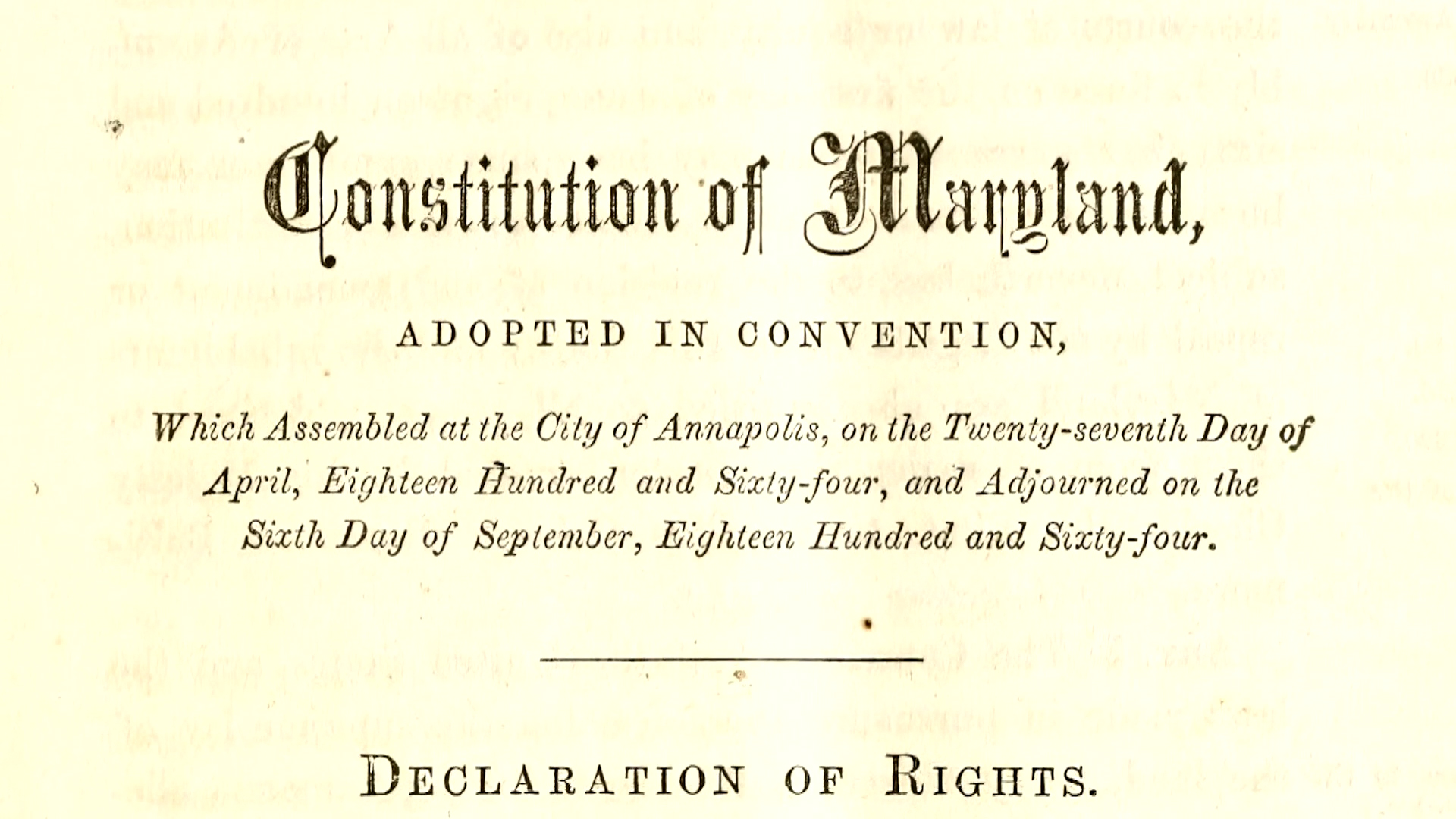
The Maryland Constitution of 1864 reshaped state government and society during the Civil War, redefining freedom, citizenship, and equality.
Maryland State Constitution of 1864
Grade 8
Before the American Civil War ended, Maryland, which bordered the North and the South, was deeply divided over the issues of slavery, states’ rights, and loyalty to the Union due to its diverse population that included both free and enslaved Black people. In 1864, Maryland delegates met to write a new state constitution that reflected the changing political and social climate.
The Maryland Constitution of 1864 officially abolished slavery in the state, required a loyalty oath for voters and public officials, and introduced changes to Maryland’s government and public education system. Although the new constitution expanded freedom for thousands of formerly enslaved people, it did not guarantee equal rights or voting rights for African Americans. The Maryland Constitution of 1864 marked a major turning point in the state's history by reshaping its government during the Civil War and laying the foundation for future struggles over civil rights and equality.
In this lesson, students will learn about the debates and decisions that shaped the Maryland Constitution of 1864 and analyze how Maryland leaders responded to the challenges of a nation at war. Students will also explore how the Constitution concurrently changed Maryland’s government by ending slavery in the state while also influencing the ongoing struggle for civil rights and equality for Maryland’s African American community.
Teacher's Guide and Related Standards
Students will be able to analyze related documents from the Maryland Constitution of 1864 to explain how it changed the state's government and society during the Civil War, and evaluate its impact on freedom, citizenship, and equality in Maryland.
- How did the Maryland Constitution of 1864 change the lives of Marylanders during and after the Civil War?
Video Clip
- How and why was a new Maryland Constitution written in 1864?
- What were the major changes introduced by the Maryland Constitution of 1864?
- Who benefited from the Maryland Constitution of 1864, and what challenges remained after its adoption?
Vocabulary
Supplemental Enrichment Activities
1864 Maryland Constitution Ratification
In 1864, Maryland delegates drafted a new constitution at the State House in Annapolis, leading to fierce debate over ending slavery. Governor Augustus Williamson Bradford proclaimed the constitution on October 29, 1864, and it took effect on November 1, officially abolishing slavery in Maryland prior to the 13th Amendment.
Provide students with an inquiry worksheet to analyze excerpts from the “Proceedings and Debates of the 1864 Constitutional Convention.” Students will investigate how state leaders decided to end slavery in Maryland before the passage of the 13th Amendment and craft an evidence-based claim that addresses the following questions:
- How was the final decision about the Maryland Constitution reached?
- How did the decisions of Maryland’s leaders shape the future of the state?
» Archives of Maryland: Proceedings and Debates of the 1864 Constitutional Convention
The Impact of Maryland Emancipation Day
The 1851 Maryland Constitution protected slavery, and the 1863 Emancipation Proclamation did not apply to Maryland because the state remained in the Union. To end slavery, Maryland adopted a new state constitution on November 1, 1864, officially emancipating thousands of enslaved Black people across the state. While emancipation brought new opportunities, it also presented significant economic and social challenges during Reconstruction.
Using the provided resource, students will complete the mapping activity to analyze the economic and social impacts of Maryland Emancipation Day on Southern Maryland communities, connecting emancipation to labor changes and Reconstruction challenges for the state as a whole.
» Southern Maryland Equity in History Coalition: Maryland Emancipation Day
Slavery and Emancipation in Maryland
Although the Emancipation Proclamation did not free enslaved people in Union-held Maryland, the state officially abolished slavery through the Maryland Constitution of 1864. However, true equality remained elusive as African Americans continued to face systematic discrimination.
Encourage students to examine how the Civil War affected enslaved people in Maryland and explore why freedom did not immediately bring social and political equality after the adoption of the 1864 Constitution.
Students will design a visual historical marker or museum exhibit layout that explains why legal emancipation did not immediately lead to social or political equality for African Americans in Maryland.
» National Park Service: Slavery and Emancipation in Sharpsburg