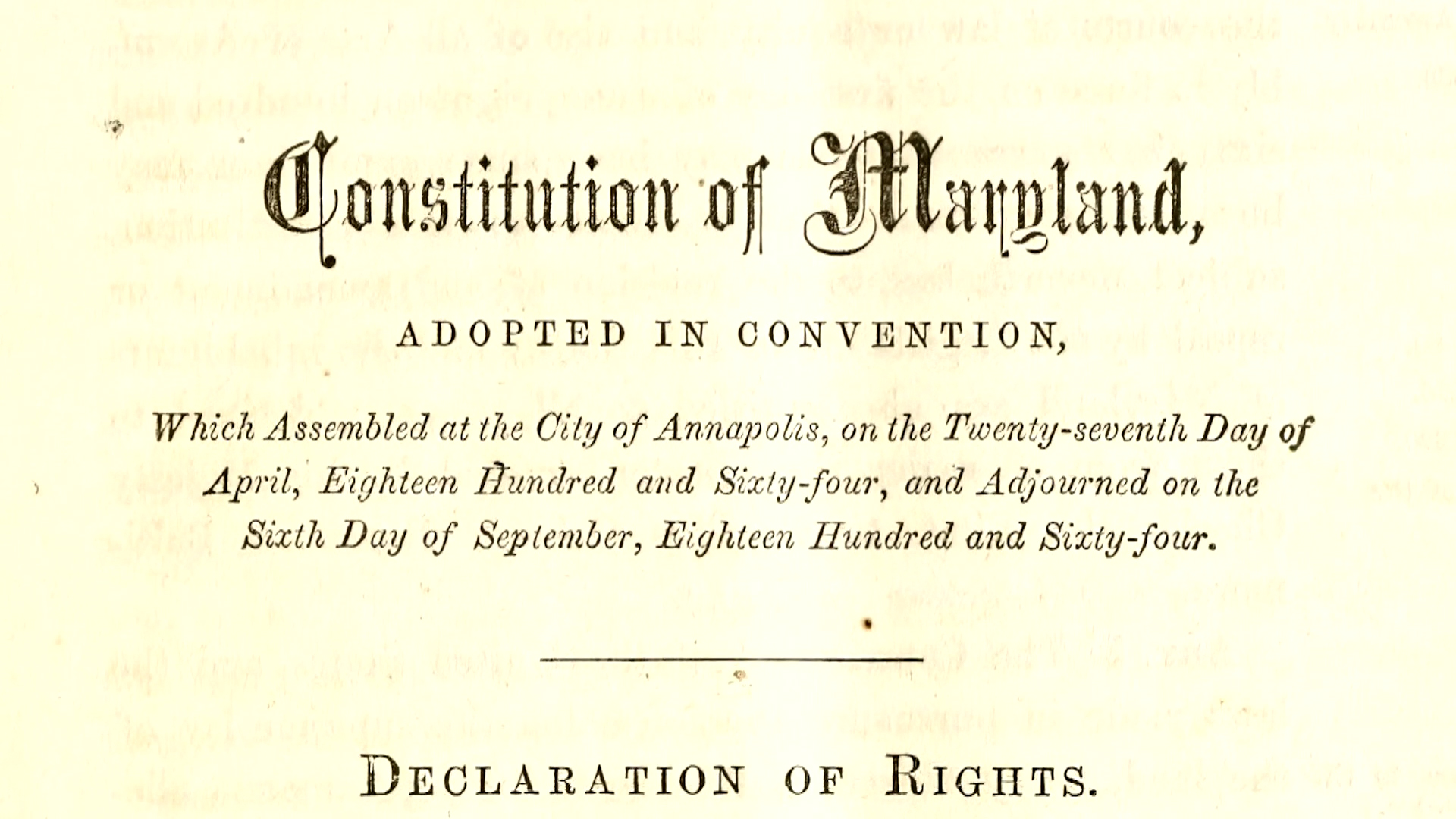
The Maryland Constitution of 1864 reshaped state government and society during the Civil War, redefining freedom, citizenship, and equality.
Maryland State Constitution of 1864
Grade 8
Teacher’s Guide and Related Standards
In this lesson, students examine the debates and decisions behind the Maryland Constitution of 1864 and analyze how state leaders responded to a nation at war. They also explore how the new constitution transformed Maryland's government by ending slavery and influencing the ongoing struggle for African American civil rights and equality.
Procedure
Students will examine documents from the Maryland Constitution of 1864 and video content to evaluate how the constitution changed state government and impacted freedom, citizenship, and equality in Maryland. Their task will be to write a summative Claim, Evidence, Reasoning (CER) paper explaining how the constitution transformed the lives of Marylanders during and after the Civil War, with options for supplemental enrichment activities.
INTRODUCTION (20 minutes)
- To connect to prior learning, teachers may ask students to discuss and provide examples of what life was like for African Americans before 1865. Teachers can also review Abraham Lincoln’s Emancipation Proclamation to make connections between the lives of African Americans during this time and the need for legislation to secure their rights.
- Explain that students will analyze related documents from the Maryland Constitution of 1864 to explain how it changed the state's government and society during the Civil War, and evaluate its impact on freedom, citizenship, and equality in Maryland. Play the video clip.
- As a class, discuss the lesson’s essential question and the thinking questions. This could be done via a whole-group discussion, such as a Socratic Seminar, or using a think-pair-share format.
EXTENSION (30 - 120 minutes)
Complete the three supplemental enrichment activities with students, as you see fit.
SUMMATIVE ASSESSMENT (30-40 minutes)
- Have students apply their newfound knowledge from the lesson by completing a summative Claim, Evidence, Reasoning (CER) paper that answers the following essential question: How did the Maryland Constitution of 1864 change the lives of Marylanders during and after the Civil War?
- Students can use the sources in the "Research Support" section to investigate the topic.
- To support their claim, students should use evidence and reasoning from the A Nation Begins: The Maryland State House at 250 video clip and activities.
- Refer to the following rubric.
REFLECTION (10 minutes)
Have students complete a reflection in response to the following questions.- Which part of this lesson was most interesting or meaningful to you? Why?
- How does this new knowledge connect to something you already know or believe?
- What choices made by people during this historical event remind me of my own choices?
- How did this specific moment in history reshape our current laws?
- How can we use the lessons from this historical event to solve a modern problem?
CER Rubric (Total: 9 Points)
| 3 Points | 2 Points | 1 Point | 0 Points | |
|---|---|---|---|---|
| Claim | The student clearly answered the question chosen. The claim fully addresses the topic. | The student answered the question, but the claim may be somewhat unclear or incomplete. | The claim is unclear, too general, or does not fully answer the question. | No claim |
| Evidence | The student used specific, accurate facts from the lesson activities. | The student used some evidence, but it may be general, lack detail, or need more explanation. | The student gave limited, weak, or unclear evidence. | No evidence |
| Reasoning | The student clearly explained how the evidence supports the claim. | The student explained their thinking, but the connection between the evidence and the claim is not fully clear. | The student’s reasoning was unclear, incomplete, and largely repeated the evidence. | No evidence |
Standards
Maryland Social Studies Standards
Standard 2.0 Peoples of the Nations and World
- Students shall inquire about the people of the United States and the world using a historically grounded, multidisciplinary approach in order to recognize multiple narratives and acknowledge the diversity and commonality of the human experience.
Standard 5.0 History
- Students shall inquire about significant events, ideas, beliefs, and themes to identify patterns and trends and to analyze how individuals and societies have changed over time to make connections to the present in their communities, Maryland, the United States, and the world.
Standard 6.0 Skills and Processes
- Students shall inquire about civics, geography, economics, history, and people and nations of the world using disciplinary literacy skills and processes to critically evaluate content through a variety of source materials across disciplines and use reading, writing, and other forms of communication to develop, defend, and critique arguments in order to take informed action.
- D2.His.1.6-8. Analyze connections among events and developments in broader historical contexts.
- D2.His.2.6-8. Classify series of historical events and developments as examples of change and/or continuity.
- D2.His.3.6-8. Use questions generated about individuals and groups to analyze why they, and the developments they shaped, are seen as historically significant.
- D2.His.4.6-8. Analyze multiple factors that influenced the perspectives of people during different historical eras.
Research Support
Archives of Maryland Online: Proceedings and Debates of the 1864 Constitutional Convention
This digital archive contains the complete proceedings, debates, and official records from Maryland’s 1864 Constitutional Convention.
National Park Service: Slavery and Emancipation in Sharpsburg, MD
This web article details the history of slavery, emancipation, and wartime experiences of African Americans in Sharpsburg, Maryland.
Southern Maryland Equity in History Coalition: Maryland Emancipation Day: Its Impact on Southern Maryland
This article examines the history and regional impact of Maryland Emancipation Day on local communities in Southern Maryland.
References
PBS, A Nation Begins: The Maryland State House at 250 - A film clip from A Nation Begins: The Maryland State House at 250 was used in this lesson. Continue to watch the full documentary to learn about the oldest state capitol in continuous legislative use—and the only one to ever serve as the capital of the United States.