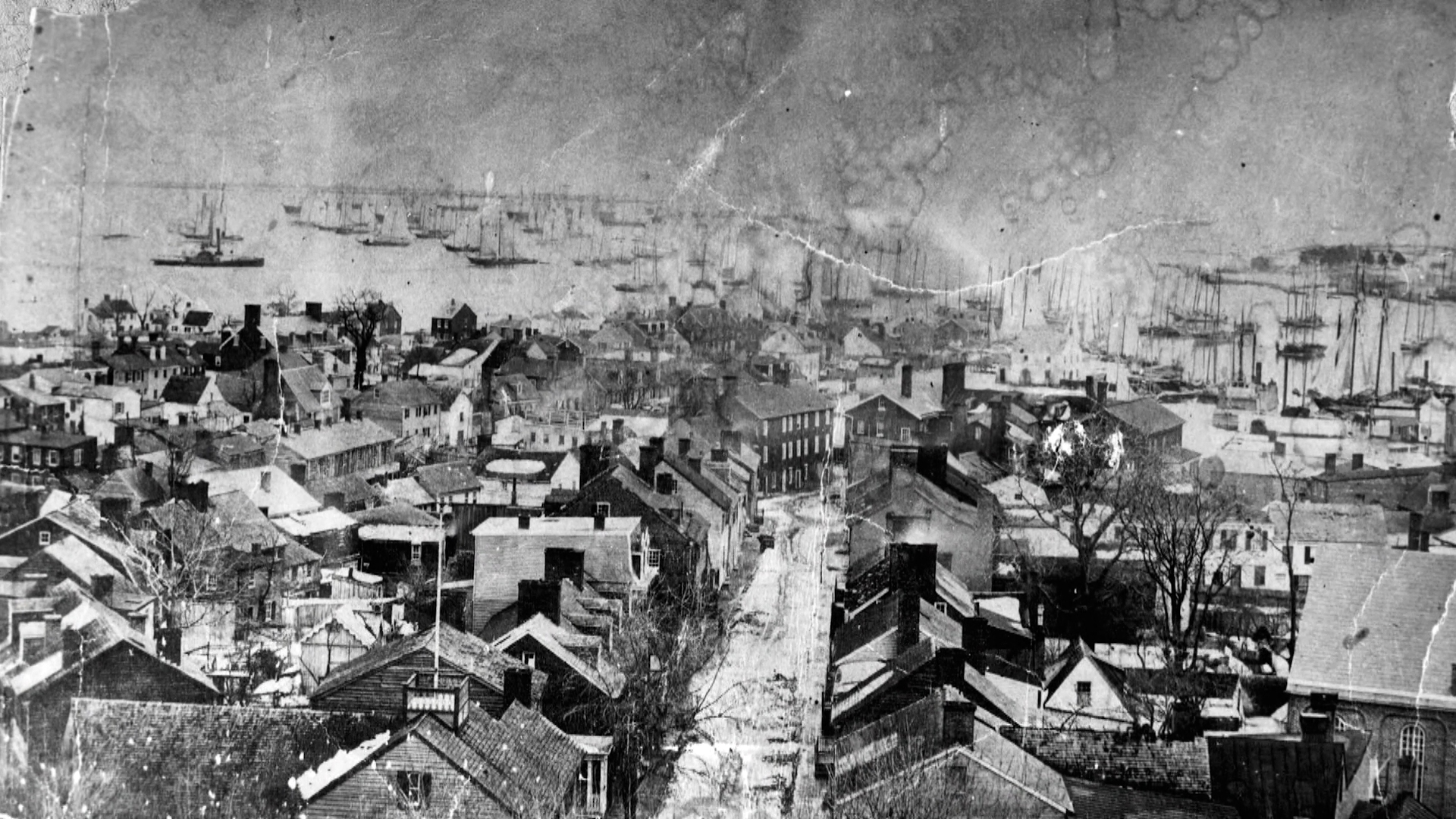
Aerial view of Annapolis, Md., in the mid-19th century.
Political Division, Past and Present
Grade 8
Since the founding of the United States in 1776, Americans have disagreed over important political issues such as the Constitution, states' rights, conflicts over slavery, civil rights, and immigration. Political division has shaped the nation's past, and it continues to influence the present. While disagreement is a natural part of democracy, the ways people respond to those differences can strengthen or weaken the country.
In this lesson, students will examine examples of political division throughout U.S. history to explore the causes and impacts of political conflict and consider how this connects to the modern-day world.
Teacher's Guide and Related Standards
Students will be able to analyze historical examples of U.S. political division to determine how conflict, compromise, and civic engagement have shaped democratic ideals over time.
- How has political division shaped democratic ideals in the United States?
Video Clip
- How did political division in the 1850s impact American society?
- What are the consequences of political polarization in a society?
- How can understanding past political divisions help society move forward?
Vocabulary
Supplemental Enrichment Activities
Political Division and the Civil War
In the 1850s, escalating disputes over slavery, state authority, and federal power deepened national divisions, leading to unresolvable political conflict and the outbreak of the Civil War. Examining these events illustrates how unaddressed political disagreements can escalate into national crises.
Have students analyze two preselected, contrasting primary sources from the Library of Congress resource collection to evaluate how political compromise broke down in the decade leading up to the Civil War, and answer the question: How did compromise break down? Provide students with an analysis worksheet to gather evidence and support their claim.
» Library of Congress: The Civil War: The Nation Moves Towards War, 1850–1861
Understanding Political Polarization
While political disagreements have always been a part of American democracy, difficulty in finding common ground can create challenges for society. In this activity, students will investigate political polarization in modern society and discuss how constructive political debate differs from extreme ideological division.
Read the Facing History article to define polarization and identify its key causes and effects. Then, have students complete a graphic organizer mapping out the differences between constructive debate and harmful polarization.
» Facing History & Ourselves: Political Polarization in the United States
Connecting Historical and Modern Divisions
Historians study the past to understand how current political divisions compare to earlier moments in U.S. history. While disagreements are a natural part of democracy, extreme division can make it difficult to find solutions and work toward common goals. Studying past conflicts helps us learn how to protect and strengthen democracy today.
Watch the video clip and provide students with this worksheet to compare political division in the 19th century to political division today. Students will write a short reflection on one action citizens can take to strengthen democratic norms.
» PBS NewsHour: Historian Compares America's Current Divisions to the Past