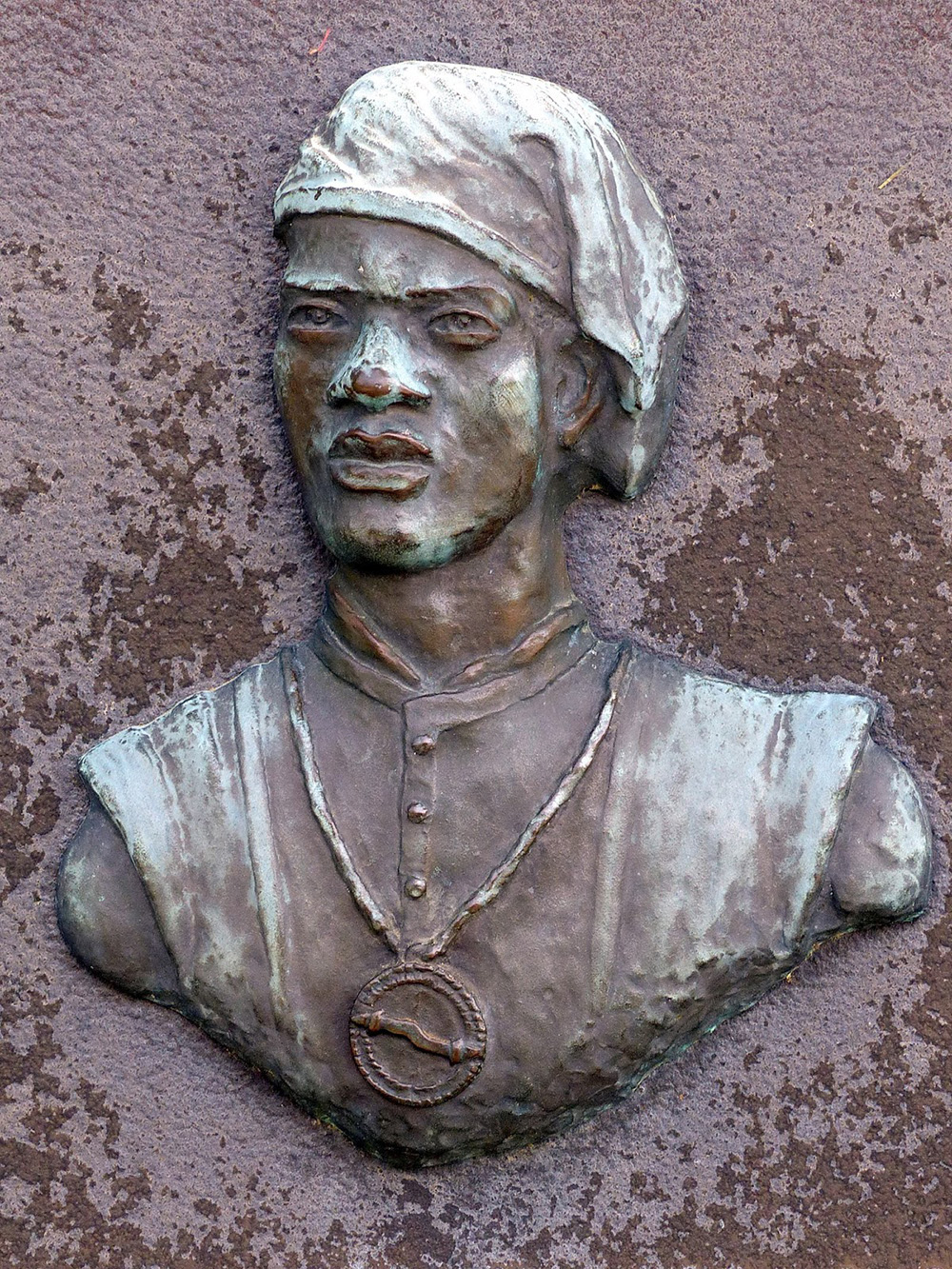
This historical marker in St. Mary's City was created to honor Mathias de Sousa in 1987. No image of de Sousa was created during his lifetime, so the sculptor, Mary de Packh, used artistic license to create a likeness to represent him.
Mathias de Sousa
Historians know very little about an early Maryland settler named Mathias de Sousa. Only a few documents record the details of his life. Some historians recognize Mathias as the first free person of African descent living in Maryland. Others simply find his life inspiring.
de Sousa was not enslaved, but rather an indentured servant who learned skills as a sailor and fur trader to win his freedom. We will likely never know some details about Mathias' life, but there are enough facts to tell his story.
de Sousa worked as an indentured servant for Father Andrew White, a Catholic priest. An indentured servant was someone who signed a contract to work for an employer for four to seven years. Sometimes servants agreed to work because they had no money and needed to pay off their debts or they simply could not find another job. Others chose to become an indentured servant to have the opportunity to settle elsewhere and start a new life, but they needed someone else to pay their way.
No matter what reason de Sousa agreed to work for Father White, his indentured servitude gave him a chance to see the New World. When Mathias voyaged to Maryland, he worked for Jesuit priests on a mission to establish churches in North America for the Catholic Pope in Rome. When Jesuit officials gave Father Andrew White the chance to settle in Maryland, he brought nine servants, including de Sousa.1 de Sousa may have also been Catholic. Likely, many of the servants who came to America with the Jesuits were Catholic.2
We don't know exactly what de Sousa did in the first few years he lived in Maryland. He likely worked with other indentured servants building houses and a new church for the Jesuits. Many servants also planted and harvested crops for food. He may have also traveled by boat to Maryland's Eastern Shore with Father White, as the priests often visited the Indigenous tribes who lived there.
Jesuits owned farmland near St. Mary's City. Governor Leonard Calvert allowed the priests and their servants to continue living and growing crops for food on this land. Land records indicate that Jesuit priests identified de Sousa as "Mathias Sousa, a Molato.”3
The term "molato" is the old spelling for "mulatto," an outdated term defined in the 17th century as a person of mixed African and European descent. "Mulatto" can also refer to the complexion (lightness or darkness) of a person's skin. We can only guess whether this refers to de Sousa’s ancestry or his skin color because historical records in the 17th century are limited. Several priests and public officials who knew de Sousa recorded all of the information known about him. Maryland government records and court cases show that de Sousa was treated better than most people of African heritage in Maryland.4
"de Sousa" is a common last name in Portugal, which perhaps is where de Sousa’s father was born. We also do not know how Mathias de Sousa thought of himself because there are no written records of what he said or thought.
Since de Sousa was an indentured servant, he worked for the Jesuits for four years. In 1638, the priests allowed de Sousa to go free. Following his servitude, he had to earn a living for himself.
During his years of service to the priests, de Sousa had learned how to sail the small ship owned by the Jesuits. He decided to earn his living as a fur trader and sailor. He earned money by trading English goods with the Susquehannocks for animal furs and food. For a few years, he continued to work for the priests. The priests made him captain of their trading ship. Later, he became captain of a trading ship owned by John Lewger, who was Secretary in the Maryland government. In March 1641, de Sousa was elected as a representative at a Maryland Assembly meeting. This proves that de Sousa was no longer a servant, as he could vote as a citizen.
1642 was a very hard year for the colonists. The Susquehannocks attacked the English settlers, and Maryland declared them enemies. de Sousa could not trade for furs during this period of hostility between the two groups. He struggled to pay his rent and buy food. He owed money to three very wealthy men: Governor Leonard Calvert, Captain Thomas Cornwallis, and John Hallowes.
We don't know about de Sousa’s life after 1643, but we do know that he lived as a sailor and trader. Important people like the Jesuits and John Lewger trusted him to be captain of their ships. They trusted de Sousa to lead white crew members on their vessels.
de Sousa’s life shows that English colonists did not always dislike someone of a different race or heritage. The English settlers saw de Sousa as a skilled, hard-working citizen. As slavery evolved into a race-based system a couple of decades later, however, the divide between Black and white Marylanders and the disparity in opportunities available to each would grow.
2For more details about Mathias de Sousa's religious beliefs, see Bogen, D. S. (2001, Spring). Mathias de Sousa: Maryland's first colonist of African descent. Maryland Historical Magazine, 96(1), 73–74.
3Land Office (Patent Record, Original). (1646–1657). Liber ABH, folio 65 [MSA S920-4]. Maryland State Archives.
4For more information about the term "mulatto" and Mathias' heritage, see Bogen, 2001, pp. 71–72; Stone, 1984, p. 9.
« Back to Library Collection
Sources:
Berlin, I. (1998). Chapter 1: Emergence of Atlantic Creoles in the Chesapeake. In Many thousands gone: The first two centuries of slavery in North America (pp. XX–XX). Harvard University Press.
Bogen, D. S. (2001, Spring). Mathias de Sousa: Maryland's first colonist of African descent. Maryland Historical Magazine , 96(1), 68–85.
Gray, S. (2000, October 6). History emerges in Md.; Settlement thought to be one of state's first. The Washington Post .
King, J. A., Chaney, E., & Ford, I. C. (2001, February 4). Defining race and identity in early Md. The Baltimore Sun .
Stone, G. W. (1984). Fur traders and field hands: Blacks in manorial Maryland, 1634–1644 [Unpublished manuscript]. Maryland State Archives, Special Collections (Biographical Series), Mathias de Sousa file, MSA SC 3520-2810.