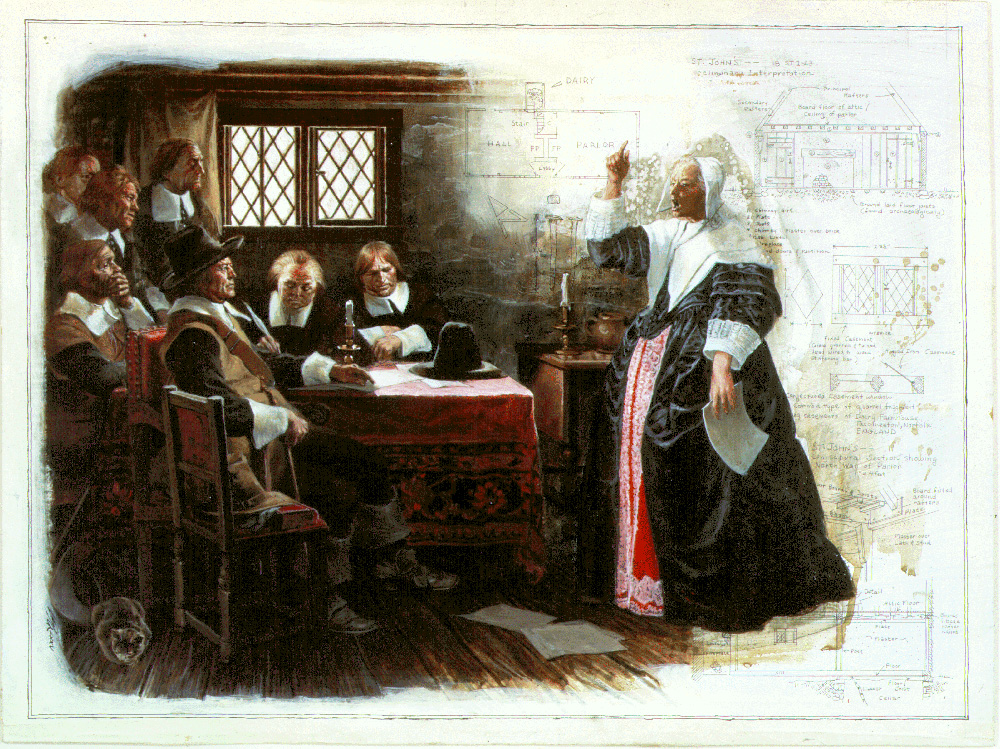
A modern painting of what Margaret Brent may have looked like, painted by Louis Glanzman, date unknown. No images of Brent from her lifetime survive.
Margaret Brent (1601-1671)
Margaret Brent stands out in Maryland's early history for her courage and independence. During a time when men outnumbered women by about six to one, and most women had to rely on their husbands for support and protection, Margaret Brent never married. Instead, she became a successful businesswoman who traded land and servants and earned the respect of Governor Leonard Calvert. He entrusted her with managing his estate upon his death.
While these achievements were both unusual and significant, Margaret Brent is best known for being the first woman in America to request the right to vote. However, the Maryland General Assembly denied her request. Margaret Brent came from a wealthy Catholic English family that had close ties to the Calverts, the proprietors of Maryland. This friendship meant that when Margaret Brent arrived in Maryland in 1638, accompanied by her sister Mary Brent and her two brothers, Giles and Fulke Brent, she was better off than most colonists. The Brents came to Maryland for religious freedom and economic opportunity, and for a while they found both.
Giles Brent settled on Kent Island and soon became a leader in the colony, but the two sisters chose to live on their own. Margaret and Mary Brent had brought several servants with them. To accommodate them, Cecil Calvert, Lord Baltimore, had generously granted the sisters patents for 2000 acres of land, "as much Land in and about the Towne of St. Maries and elsewhere in that Province in as ample manner and with as large priviledges as any of the first adventurors have."
Margaret Brent soon became skilled at business. She profited from lending money to new immigrants. Both she and her sister, but particularly Margaret, appeared in court to collect debts and manage their affairs. Although unusual, Margaret Brent’s economic activities were not illegal or unprecedented. As long as she remained single, a woman could own and manage property. However, once a woman married, she lost the power to make contracts, and her husband gained control of her property. In an era when nearly all women in early Maryland married, Margaret Brent's decision to remain single made her stand out in the colony's history.
In 1642, civil war broke out in England, and rebellion spread to Maryland a few years later. In 1645, a Protestant ship captain, Richard Ingle, led a surprise attack on the Catholic settlers in Maryland. Margaret Brent’s brother Giles Brent was captured and taken to England, while Governor Calvert fled to Virginia, leaving the colony in disarray. A year later, the governor returned with a group of hired soldiers from Virginia and successfully defeated Ingle and his supporters.
Unfortunately, Governor Calvert became ill shortly after his return. On his deathbed, he appointed Thomas Greene to replace him as governor and named Margaret Brent as his executrix, in charge of paying his debts and disposing of his estate. He instructed her to "take all and pay all."1 It was not uncommon for a woman, usually the dead man's wife, to be named executrix, but Margaret Brent’s situation was unique. She was not Calvert's wife, and she soon had to deal with a problem that could affect the colony's survival.
Not long after Leonard Calvert’s death, the soldiers whom he had hired to protect his colony began to demand their pay. Brent had used the governor's money to pay his other debts and did not have enough left for the soldiers. They became restless and threatened mutiny. Margaret Brent quickly took steps to prevent this.
Leonard Calvert had been serving as attorney in Maryland for his brother Cecil, the second Lord Baltimore. Margaret Brent went to the Provincial Court and asked that she be named Lord Baltimore's attorney in Leonard's place. Her request was granted. Margaret Brent then took the step for which she is most famous: being the first woman to request the right to vote.
On January 21, 1648, Brent went before the all-male Assembly and asked for two votes — one for herself as a landowner and one as Lord Baltimore's attorney. She hoped to convince the Assembly to pass a tax to help pay the disgruntled soldiers. However, the Assembly, particularly the new governor, was not ready to give a woman such power and denied her request.
Barred from the assembly, Brent did not give up. Using her authority as Lord Baltimore's attorney, she began selling some of his cattle to pay the soldiers and thus prevented an uprising. Her quick actions saved Maryland, but they angered Lord Baltimore, who did not like having his cattle sold without his permission.
He wrote a letter expressing his disapproval of what Margaret Brent had done, but the Assembly defended her. They wrote to Lord Baltimore, saying, "We do Verily Believe and in Conscience report that it was better for the Collonys safety at that time in her hands than in any mans else in the whole Province; for the Soldiers would never have treated any other with that Civility and respect and though they were even ready at several times to run into mutiny yet she still pacified them. She rather deserved favour and thanks from your Honour for her so much Concurring to the publick safety then to be justly liable to bitter invectives."2
Unfortunately for Margaret Brent, Lord Baltimore was not convinced by the Assembly's claims. Possibly because of Lord Baltimore's displeasure, in 1649 Margaret Brent and her brother Giles Brent, who had also fallen out of the Calverts’ favor, moved to Virginia. She acquired a large tract of land, which she named "Peace," and lived there until she died in 1671.
Margaret Brent did not succeed in becoming the first woman in America to gain the right to vote. Still, she helped protect Maryland's stability and ensured the colony's survival. She deserves recognition for her independence and her brave actions in appearing before the Maryland General Assembly and doing all in her power to preserve control of the colony for the Calvert family.
2Assembly letter praising Margaret Brent. (1638/1664). In Archives of Maryland: Vol. 1. Proceedings of the General Assembly, January 1637/8–September 1664 (p. 239). Maryland Historical Society. (Original record: General Assembly [Upper House], Liber M.C., folio 342, MSA S977-1, 2/20/4/42)
« Back to Library Collection
Sources:
Books
Carr, L. G. (n.d.). Notes on Margaret Brent. Historic St. Mary's City Commission.
James, E. T. (Ed.). (1971). Notable American women: A biographical dictionary (Vols. 1–3). Belknap Press of Harvard University Press.
Jensen, A. (1990, June). "Is this justice?": A woman's plea in colonial Maryland puts Margaret Brent ahead of her time. Annapolitan, 47–49.
Loker, A. (1999, Spring). Barristers, brigands, and Brents: Margaret Brent, attorney, adventurer, and America's first suffragette. A Briefe Relation (Historic St. Mary's City Foundation and Friends Newsletter).
Maryland State Archives. (n.d.). Maryland history leaflet no. 1. Prepared for use of Government House.
Masson, M. W. (1977). Margaret Brent, c. 1601–c. 1671: Lawyer, landholder-entrepreneur. In W. G. Helmes (Ed.), Notable Maryland women (pp. XX–XX). Tidewater Publishers.
Notes on "colonial women of Maryland." (n.d.). Maryland Magazine, 2, 379.
Ramey, M. E. W. (1915). Chronicles of Mistress Margaret Brent [Pamphlet].
Roberts, M. C. (n.d.). Margaret Brent, "gentleman" [Pamphlet]. St. Mary's Economic Development Commission.
Spruill, J. C. (1934, December). Mistress Margaret Brent, spinster. Maryland Historical Magazine, 29, 259–269.