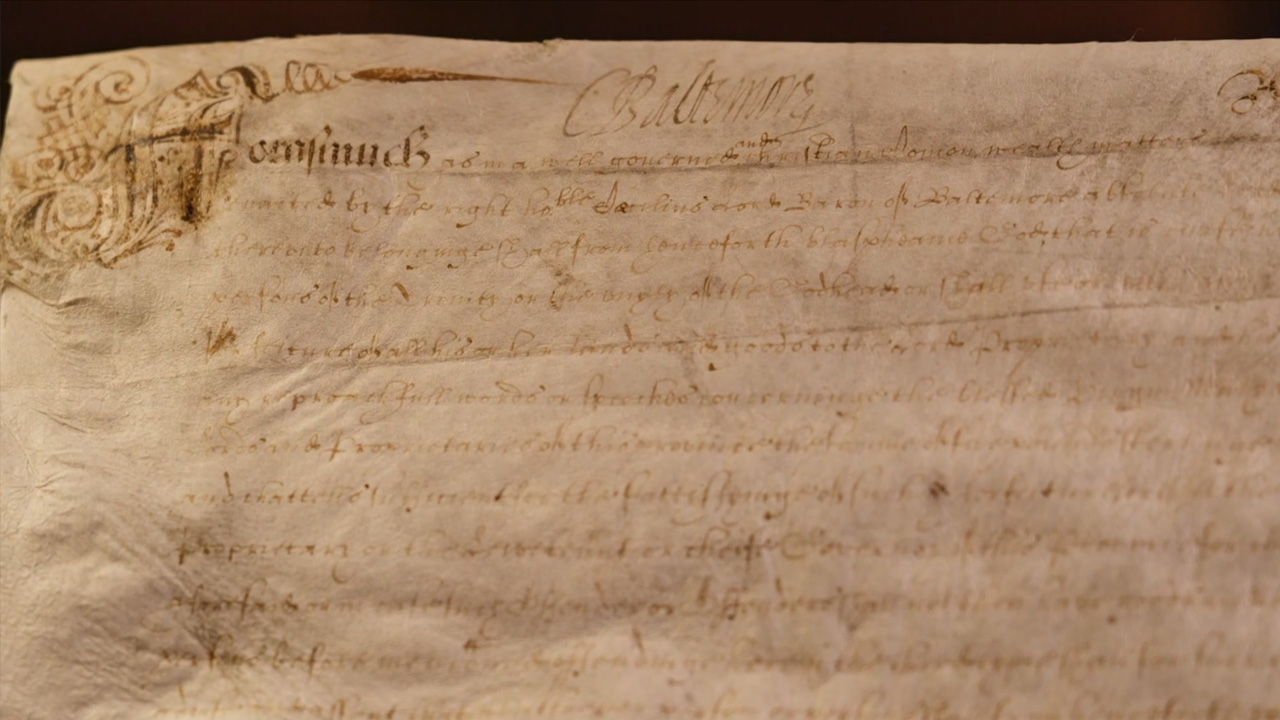
Religious Freedom in Colonial Maryland
Grade 4
Teacher’s Guide and Related Standards
In this lesson, students will learn why religious freedom was important to Maryland and how laws like the Maryland Toleration Act shaped life in the early colony.
Procedure
INTRODUCTION (20 minutes)
- To hook students into the lesson, write two columns on the board:
Personal Choice | Rules for Everyone- Ask students where these belong:
- Games you like
- Books you read
- What time school starts
- How people treat each other
- Foods people eat
- Next, discuss by asking these questions:
- Why are some things personal choices?
- Why do some things need rules?
- Then explain: In colonial Maryland, leaders had to decide whether people should have personal choices about their beliefs or if everyone should follow the same rules.
- Explain that students will be learning about a time when different groups of settlers in Maryland disagreed strongly. To maintain peace, leaders created a law called the Act Concerning Religion, also known as the Maryland Toleration Act. Play the video clips. Pause between each clip for discussion and clarification.
- Either as a class or in small groups, discuss the Essential Questions and Thinking Questions.
EXTENSION (30-120 minutes)
Complete the supplemental extension activities with students, as you see fit.
SUMMATIVE ASSESSMENT (30 minutes)
- Have students apply their newfound knowledge by using the Claim, Evidence, Reasoning (CER) framework to analyze the lesson and support their responses using evidence from the videos and activity resources.
- How successful was Maryland’s Toleration Act in protecting religious freedom?
REFLECTION
- What part of this lesson connected with you most? Why?
- How does the new knowledge you gained about religious freedom in colonial Maryland connect to something you already knew or believed?
- Why do you think laws like the Maryland Toleration Act were created? Do you think they were fair? Why or why not?
- How important do you think religious freedom is today? How important do you think it was for people living in colonial Maryland?
Standards
MSDE 4.2.1
Students will compare Maryland’s colonial experience with other colonies by: analyzing religious conflict among European settlers in Maryland and evaluating the effectiveness of the Toleration Act on different religious groups. (4.2.1.c)
- D2.Civ.3.3-5. Examine the origins and purposes of rules, laws, and key U.S. constitutional provisions.
- D2.Civ.12.3-5. Explain how rules and laws change society and how people change rules and laws.
- D2.His.4.3-5. Explain why individuals and groups during the same historical period differed in their perspectives.
CER Rubric (Total: 9 Points)
| Category | 3 Points | 2 Points | 1 Point | 0 Points |
|---|---|---|---|---|
| Claim | I clearly answered the question I chose (geography’s influence or archaeology’s importance). My claim fully addresses the topic. | I answered the question, but my claim may be somewhat unclear or incomplete. | My claim is unclear, too general, or does not fully answer the question. | No claim. |
| Evidence | I used specific, accurate facts from the lesson (e.g., geography, natural resources, climate, artifacts, buildings, or discoveries). | I used some evidence, but it may be general, lack detail, or need more explanation. | I gave limited, weak, or unclear evidence. | No evidence. |
| Reasoning | I clearly explained how my evidence supports my claim and connects to geography or archaeology. | I explained my thinking, but the connection between the evidence and the claim is not fully clear. | My reasoning was unclear, incomplete, and largely repeated the evidence. | No reasoning. |
Teacher Resources
- Historic St. Mary’s City, For Teachers: A Brief History of St. Mary's City — This brief overview of the history of St. Mary’s City covers many subjects, including the religious composition of the town on pages 8-9.
- MD Two Fifty: Religious Toleration in Maryland Law — This page includes an article about the history of religious tolerance in Maryland and the impact of the Act of Religious Tolerance.
- Facing History & Ourselves, Religion in Colonial America: Trends, Regulations, and Beliefs — This article provides an in-depth look at how religion shaped society in New England, mid-Atlantic, and Southern colonies.
References
PBS, Liberty of Conscience: The Founding of Maryland - A film clip from Liberty of Conscience: The Founding of Maryland was used in this lesson. Continue to watch the full documentary to learn more about the founding of colonial Maryland and the influence of the Calvert family.