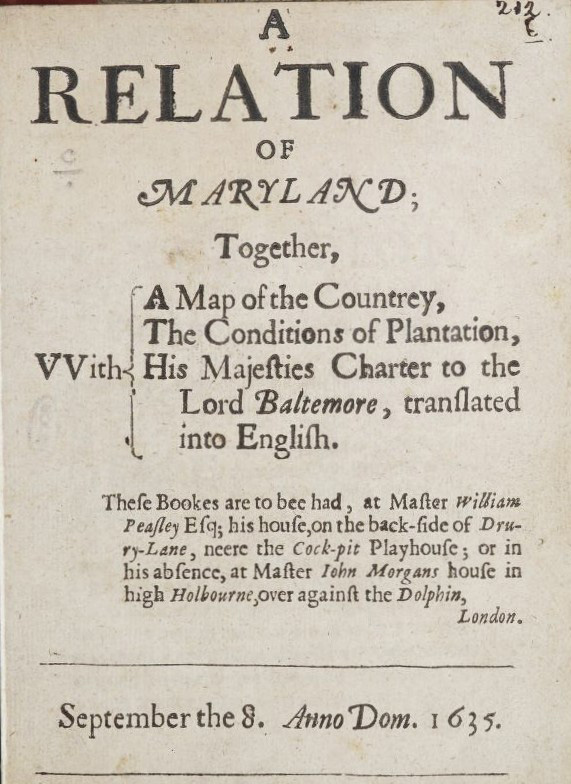
The title page of John Lewger and Jerome Hawley's 1635 promotional pamphlet, A Relation of Maryland.
John Lewger (1602-1665)
John Lewger was not one of the first colonists to come to Maryland in 1634 on the Ark or the Dove, but that did not stop him from becoming one of the colony's most important men.
Lewger was born in England in 1602. When he was 14, he went to school at Trinity College, Oxford. There he met Cecil Calvert and the two became friends. Lewger became a priest in the Church of England, but later decided he needed a job that paid more. He had a wife and a small son to support, so he moved to London to find work.
In London, Lewger ran into his old friend Cecil Calvert, who had become the proprietor of the new colony of Maryland. Calvert offered Lewger a job as Secretary of the Province in his new colony. In November 1637, John Lewger, his wife Ann, and their nine-year-old son, also named John, arrived in Maryland on the ship Unity.
Lewger was very good at his job, and he helped ensure that everything in the colony ran as smoothly as possible. He was also appointed to Maryland’s Council, which advised the governor. Lewger was later made Attorney General. In this role, Lewger acted as a judge, kept records, wrote down the laws passed by the Assembly, and collected all money owed to the proprietor. In 1648, Lewger returned to England, but during his time in the colony, he proved very loyal to the Calvert family and helped the colony get off to a good start.
« Back to Library Collection
Sources:
Maloney, E. J. (1996). Papists and Puritans in early Maryland: Religion in the forging of provincial society, 1632–1665 (Publication No. 9637195) [Doctoral dissertation, State University of New York at Stony Brook]. ProQuest Dissertations and Theses Global.
Papenfuse, E. C., Day, A. F., Jordan, D. W., & Stiverson, G. A. (1979–1985). A biographical dictionary of the Maryland legislature, 1635–1789 (Vols. 1–2). Johns Hopkins University Press.
Hawley, J., & Lewger, J. (1910). A relation of Maryland (1635). In C. C. Hall (Ed.),Narratives of early Maryland, 1633–1684 (pp. 63–112). Charles Scribner's Sons.