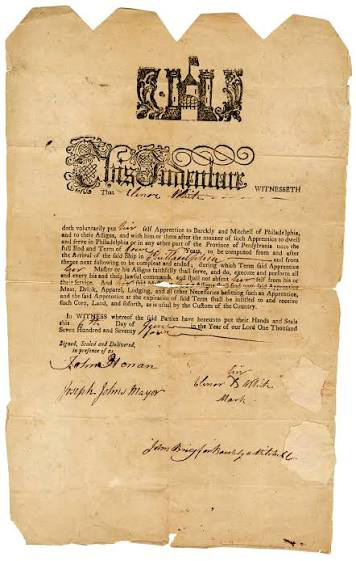
This is an example of an indentured servant's contract from the 1600s, though it was not Daniel Clocker's. No image of Daniel Clocker or his indenture exists today.
Daniel Clocker (c.1619-1676)
Daniel Clocker’s life demonstrates how a poor white indentured servant might find opportunities in the colonies to improve their position in society. Records of his life are limited, but scholars have made informed interpretations of how he might have lived.
Daniel Clocker was most likely born in Cumberland County in northern England. Later in life, he came to America to seek his fortune. In England, the population was growing, and jobs were scarce. Clocker may have thought that the New World offered more opportunity for a young man willing to work. On the other hand, perhaps he was seeking adventure. He was only 17 years old when he left for America. He was old enough to want to be out on his own but still a teenager with hopes and dreams.
Unlike sons of wealthy families who went to college in England, Clocker was not well-educated. He could not write his name and most likely could not read. When he came to Maryland in 1636, he could not afford to pay for his passage across the Atlantic Ocean, so he became an indentured servant, agreeing to work for a master for four years. His master was Thomas Cornwallis, a very wealthy man and one of the leaders of the Maryland colony.
Most likely, Clocker was put to work growing tobacco, the colony’s main cash crop. He could also have been put to work building a fort or temporary houses to protect and provide shelter for the new settlers. Life was not easy for Clocker. Like most servants, he had to work hard for long hours. Some masters would even beat their servants or not give them enough food. A servant could be sold without their consent, making life very uncertain.
In the early years of the colony, about 20 to 30% of immigrants died from disease. The average man lived only 43 years. However, if an immigrant survived his servitude, as Daniel Clocker did, he had a good chance of becoming a successful member of the community. After serving his time, Clocker married Mary Lawne Courtney, who had also been an indentured servant.
Mary was a widow with a young son. Because there were not many women in Maryland, and because it could be difficult for a woman to survive on her own unless she were rich, it was not unusual for a woman to remarry. Clocker is believed to have worked as a carpenter, while his wife Mary served as the local midwife and also worked as a dairymaid. Sometimes she would sell butter or cheese to her neighbors to help support the family.
Clocker acquired 150 acres of land, plus a small plot in town where he likely built a house. He became a respected member of the community. In 1655, Clocker was appointed Justice of the Peace for St. Mary's County, and later served as a member of the common council of St. Mary's City.
When Daniel Clocker died in 1676, he was not rich, but his possessions suggested he lived comfortably. He was also a landowner, something that would have been very unlikely if he had stayed in England. It is reasonable to suggest that Clocker was much better off at the time of his death than when he first arrived in Maryland as a poor servant.Not all servants were as lucky as Daniel Clocker, but for those who survived, Maryland could provide an opportunity to better one's position in the world.
« Back to Library Collection
Sources:
Carr, L. G. (1999). Daniel Clocker's adventure: From servant to freeholder. In I. K. Steele & N. L. Rhoden (Eds.), The human tradition in colonial America (pp. 97–118). Scholarly Resources.