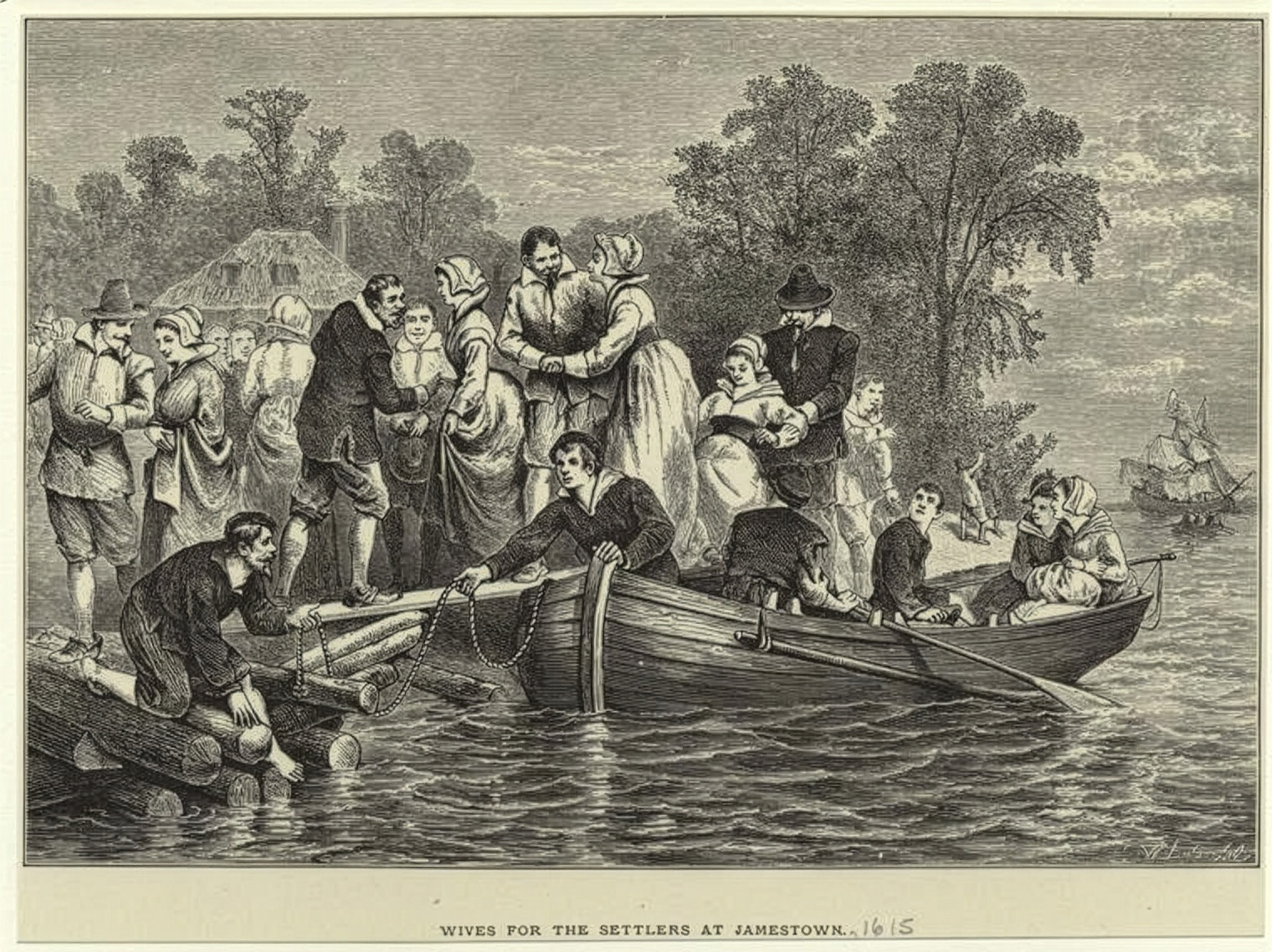
This 1876 wood engraving depicts women from England who hoped to marry planters as they arrived in Jamestown. It was created with a historical eye more than 250 years after the event took place.
Wife of a Planter
Most men in colonial Maryland arrived as indentured servants and, after completing their terms, many became small farmers growing tobacco and other crops. Many women who came to the Chesapeake Bay area did not come as part of a family, and like men, came as indentured servants. Some of these women hoped to make a better life for themselves in the New World by marrying a wealthier man who could acquire land and provide for a family. Women who married these planters became planters' wives.
The majority of women who arrived in the Maryland colony were between 18 and 25 years old, but were not free to marry right away. Because many women did not have the money to pay for their passage to America, they became indentured servants. Indentured servants usually worked for a master for four to seven years to pay off the cost of their voyage. Women who worked for wealthy families worked as house servants, but less well-off families often needed their female servants to help in the fields growing tobacco or corn. This was a new and different lifestyle for women who came to Maryland, because English women did not typically do field work.
Women also risked becoming very sick or dying from several new illnesses that settlers encountered in the New World. If they survived their first few years, they had a good chance of finding a husband who could provide for and protect them, and most women married in their mid-20s after their indenture contracts ended. For many women, marriage seemed necessary because during this time period, women did not have the same legal rights as men to own their own property or make decisions for themselves. Because significantly more men than women settled in Maryland, women had more potential husbands to choose from. This gave women more opportunities than they had in England, including opportunities to improve their social status.
Some men were so desperate for a wife that they paid a female servant’s master for her time so she was free to marry before she had served her full term. Although a married woman was free from servitude, life still was not easy for most women. Either she or her husband was likely to die within the first seven years of their marriage. She would probably have three or four children, but only two were likely to survive to adulthood. Harsh conditions in the colony and limited medical knowledge contributed to the high rates of mortality.
As the wife of a planter, a woman might still have to help in the fields if her husband wasn’t rich enough to hire a servant. She would also spend much of her time preparing food and running the household. Cooking required much more work during the colonial period. For example, to make a loaf of bread, a woman had to shell the corn from the ears, pound the corn into flour, and then use the flour to make bread. She would also have to make her own butter and cheese using the milk from the family’s cows.
It was highly likely that a woman would die before she was 43 years old. Life was hard for those who first came to Maryland, but some women were still better off than they had been in England.
« Back to Library Collection
Sources:
Carr, L. G., & Walsh, L. S. (1977). A planter's wife: The experience of white women in seventeenth-century Maryland. Institute of Early American History and Culture.