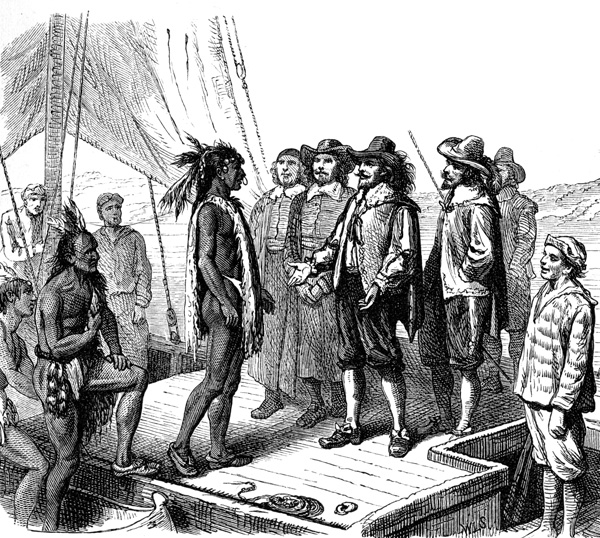
This 1876 textbook illustration is described as portraying the first meeting of Leonard Calvert and the chief of the local native people.
Wannas, Tayac of the Piscataway
The 1632 Charter of Maryland1, named in honor of Queen Henrietta Maria, wife of King Charles I, gave control of an area northeast of the territory of Virginia to the family of Ireland’s Baron of Baltimore. Leonard Calvert was appointed governor of Maryland by his brother, the Baron. The charter gave Calvert permission to wage war on the Indigenous people who lived there. Calvert, along with Catholic missionary Father Andrew White and a group of around 200 colonists and indentured servants, landed at St. Clement's Island in southern Maryland on March 25, 16342. This date is still celebrated as Maryland Day.
Advised by a Chesapeake trader, Captain Henry Fleete, Governor Calvert sailed from St. Clements to Piscataway to speak with the tayac, Wannas. Calvert wanted to discuss a nearby place where his group could settle. According to Father White's journal, Calvert’s group encountered 500 bowmen but was able to speak with the Piscataway leader. Wannas wisely did not advise Calvert to leave or stay but reminded the governor that actions have consequences.3
Governor Calvert decided to sail back and later, once again accompanied by Captain Fleete, the governor was led to a Yaocomico settlement. Calvert took over the area, renaming it St. Mary’s4. According to Calvert, Wannas was killed by his own brother, Kittamaquund5. In 1636, Kittamaquund became the new tayac of the Piscataway.
2Maryland Secretary of State. (n.d.). Maryland's history: Pre-colonial history. https://sos.maryland.gov/mdkids/Pages/Maryland's-History.aspx
3Coxe Toogood, A. (1969, September). Piscataway Park Maryland: General historic background study (pp. 25–26). U.S. Department of the Interior, National Park Service. https://npshistory.com/publications/pisc/gen-hist-background.pdf
4 Hawks, F. L. (1865). A relation of Maryland: Reprinted from the London edition of 1635 (pp. 8–10). (Original work published 1635)
5Hall, Clayton Colman, Editor, Narratives of early Maryland, 1633-1684 (1910), pp. 158-59.
« Back to Library Collection