An Act Concerning Negroes and Other Slaves
The 1663 resolution, “An Act Concerning Negroes and Other Slaves,” mandated slavery for all African and African-descended people in the colonies. The following passage is the text from the original document. You will notice old legislative language (“be it enacted”) and also a lot of irregular spellings (“u”s where “v”s should be, extra “e”s, double letters).
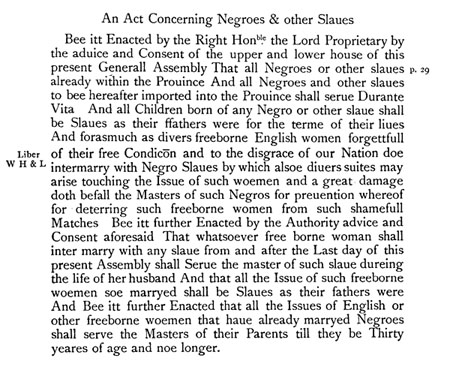
Below, you’ll find the text slightly edited to use modern spellings, capitalization, and punctuation. The summaries added between each section explain the different parts of this law.
An Act Concerning Negroes & other Slaves
“Be it enacted by the right honorable the Lord Proprietary by the advice and consent of the upper and lower house of this present General Assembly that all negroes or other slaves already within the province and all negroes and other slaves to be hereafter imported into the province shall serve durante vita and all children born of any negro or other slave shall be slaves as their fathers were for the term of their lives…”
Summary: All Africans, African-descended people, and other enslaved people, in the colony now and brought to the colony in the future, will be enslaved for life.
“And forasmuch as diverse free-born English women, forgetful of their free condition and to the disgrace of our nation, do intermarry with negro slaves, by which also diverse suits may arise touching the issue of such women and a great damage doth befall the masters of such negroes, for prevention whereof for deterring such free-born women from such shameful matches, be it further enacted by the authority, advice, and consent aforesaid that whatsoever free-born woman shall intermarry with any slave from and after the last day of this present assembly shall serve the master of such slave during the life of her husband and that all the issue of such free-born women so married shall be slaves as their fathers were…”
Summary: To discourage free English women from marrying enslaved (or African) men, those women who married after the law was made would become enslaved to their husbands’ enslavers for their husbands’ lifetime. Children of these couples would also be enslaved (in this case, “issue” means children).
“And be it further enacted that all the issues of English or other free-born women that have already married Negroes shall serve the masters of their parents till they be thirty years of age and no longer.”
Summary: Children of English women and African or enslaved men who were already married before the law was made would be enslaved until age 30.
From Proceedings and Acts of the General Assembly January 1637/8-September 1664, Maryland State Archives