Kittamaquund, Tayac of the Piscataway (d. 1641)
(Alternative spelling = Chitomachon)
Vocabulary
- Piscataway: Native American Nation located in Central Maryland
- Tayac: Leader of the Piscataway
- Susquehannocks: Native American Nation located in Central Maryland and the Eastern Shore Jesuit: A member of the Society of Jesus, a Roman Catholic religious order
- Eastern Shore Jesuit: A member of the Society of Jesus, a Roman Catholic religious order
- Blood-letting: The historical medical practice of removing blood from a patient
- Legacy: The lasting impact, values, and memories a person leaves behind
The Native peoples of southern Maryland played an important role in the founding of the Maryland colony. While there was some conflict between the native population and the colonists, others, like the Piscataway, became their allies and trading partners.
Kittamaquund was an important Piscataway warrior and the younger brother of a man named Wannas. Wannas served as the Piscataways’ head chieftain, or tayac, when Governor Leonard Calvert arrived in 1634. "Tayac" is the Piscataway word meaning "emperor" or "ruler of all the chiefs.” He was the main leader of the Piscataway.
The Piscataway tayac ruled over 130 miles of native land and villages on the both shores of the Chesapeake Bay. Kittamaquund and his followers saw that Wannas mistrusted the English. They were worried that Wannas might lead the Piscataway to a deadly war against the colonists. Kittamaquund killed his brother in 1634, and became tayac in his place.1 As the new tayac, Kittamaquund led his people to peaceful ties with the Maryland colonists.
Some of the Piscataway were upset that Kittamaquund had killed Wannas. However, Kittamaquund also had friends among his people. They thought their new tayac was wise. They also wanted the benefits of English fur trade and military protection against their enemies, the Susquehannocks.2
Father White visited Kittamaquund in June 1639. Father Andrew White was a Jesuit priest who had learned some of the native language and who wanted to teach the native peoples about his Christian beliefs. The tayac liked Father White, and invited the priest to live in his home with his family. Later that year, Kittamaquund became sick. The native medicine men could not cure him. Father White cured him with some English medicine powder and blood-letting.3
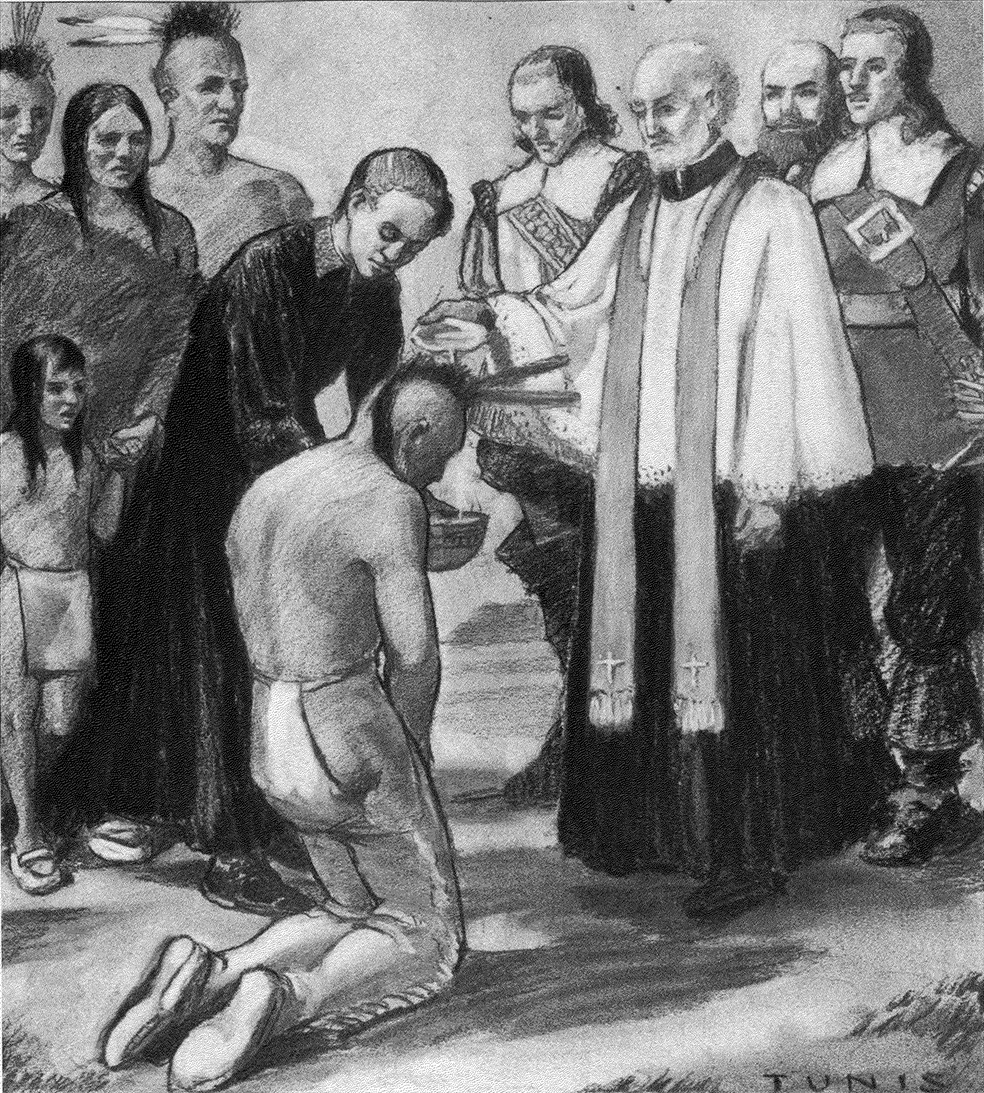
Kittamaquund was so grateful that he allowed Father White to teach him about Christianity. He also adopted the colonists' English style of clothes and learned to speak some of their language.4 Kittamaquund decided to convert to Christianity in 1640. He asked to be baptized along with his wife and daughters. Other Piscataway leaders decided to become Christians with their tayac.
Father Andrew White performed Kittamaquund's baptism on July 5, 1640. Maryland’s colonial governor, Leonard Calvert, other Maryland leaders, and Piscataway leaders all attended the event. The ceremony took place at a chapel built with bark walls, just like other Piscataway buildings. During the baptism, the priests gave the Piscataway English Christian names. Kittamaquund's name became Charles, and his wife was named Mary.5 Kittamaquund's daughter, also named Mary, went to live with the Brent family and later married Giles Brent.6 Kittamaquund died a year later in 1641, leaving a lasting legacy for the Piscataway.7
1"Annual Letter of the English Province of the Society of Jesus, 1639," in Clayton Colman Hall, ed., Narratives of Early Maryland, 1633-1684 (New York: Barnes & Noble, Inc., 1910) 126; "Letter of Governor Leonard Calvert to Lord Baltimore, 1638," in Hall, ed. Narratives of Early Maryland, 158-159; Archives of Maryland, vol. 3, 454.
2For detailed information about Wannas' and Kittamaquund's relationships with the English colonists, see James H. Merrell, "Cultural Continuity among the Piscataway Indians of colonial Maryland," William and Mary Quarterly, vol. 36 (4) (Oct. 1979): 548-570.
3"Annual Letter of 1639," 126; Merrell, "Cultural Continuity," 557.
4"Annual Letter of 1639," 127.
5"Annual Letter of 1640," 131; Timothy B. Riordan, The Plundering Time: Maryland in the English Civil War, 1642-1650 ( St. Mary's City, Maryland, forthcoming publication), 3-6.
6Archives of Maryland vol. 15, "Preface," p. 8
7"Annual Letter of 1642," 136.
Sources:
- Clayton Colman Hall, ed. "Extracts from the Annual Letter of the English Province of the Society of Jesus, 1639, 1640, 1642." In Narratives of Early Maryland, 1633-1684. New York: Barnes & Noble, Inc., 1910.
- Hughes, Thomas. History of the Society of Jesus in North America: Colonial and Federal Documents, 1605-1838, 4 vols. London and New York: Longmans, Green and Co., 1908.
- Roundtree, Helen C. and Thomas E. Davidson. "Chapter Three: The First Century with Maryland." In Eastern Shore Indians of Virginia and Maryland. Charlottesville and London: University of Virginia Press, 1977.