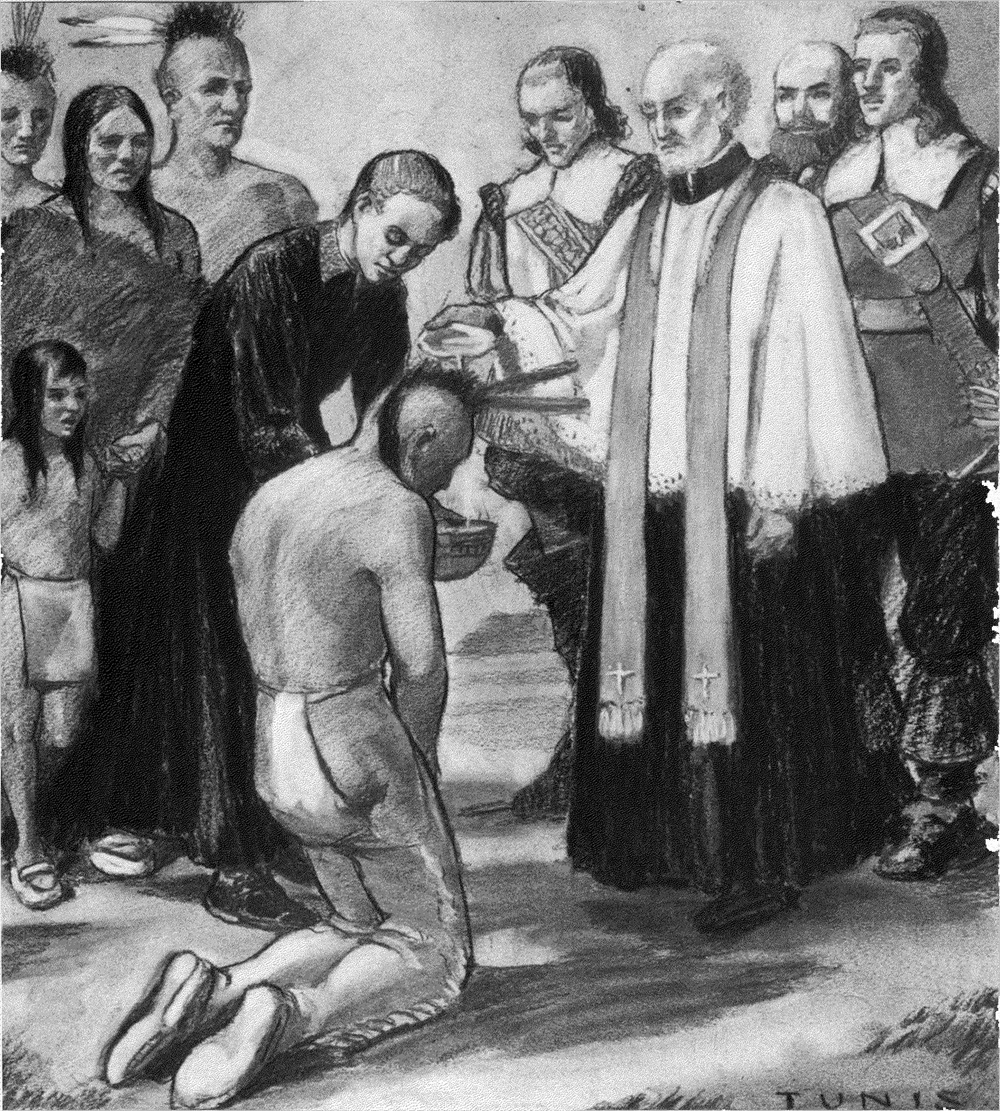
This 20th-century image created by book illustrator Edwim Tunis imagines the baptism of Kittamaquund by Father Andrew White. No image of Kittamaquund from his lifetime survives.
Kittamaquund
The Indigenous peoples of southern Maryland played an important role in the founding of the Maryland colony. While there was some conflict between the native population and the colonists, others, like the Piscataway, became their allies and trading partners.
Kittamaquund was an important Piscataway warrior and the younger brother of Wannas, who, for a time, served as the tribe’s tayac, or head chieftain, when Governor Leonard Calvert arrived in 1634. Tayac is the Piscataway word for the chief who leads all the village chiefs. Wannas was the main leader of the Piscataway.
The Piscataway tayac ruled over 130 miles of Native land and villages on both shores of the Chesapeake Bay. Kittamaquund and his followers saw that Wannas mistrusted the English. They worried that the Wannas might lead the Piscataway into a deadly war with the colonists. In 1634, Kittamaquund killed his brother and replaced Wannas as the tayac. As the new tayac, Kittamaquund led his people to peaceful ties with the Maryland colonists.
Some of the Piscataways were upset that Kittamaquund had killed Wannas; however, Kittamaquund also had friends among his people. They thought their new tayac was wise. They also wanted the benefits of the English fur trade and military protection against their enemies, the Susquehannocks.
Father Andrew White visited Kittamaquund in June 1639. Father White was a Jesuit priest who had learned some of the Piscataway language and wanted to teach them his Christian beliefs. The tayac liked Father White, and invited the priest to live in his home with his family. Later that year, Kittamaquund became sick. The Piscataway medicine men could not cure him. Father White cured him with some English medicine powder and blood-letting.
Kittamaquund was so grateful that he allowed Father White to teach him about Christianity. He also adopted the colonists' English style of clothes and learned to speak some of their language. Kittamaquund decided to convert to Christianity in 1640. He asked to be baptized along with his wife and daughters. Other Piscataway leaders decided to become Christians with their tayac.
Father White baptized Kittamaquund on July 5, 1640. Maryland’s colonial governor, Leonard Calvert, other Maryland leaders, and Piscataway leaders all attended the event. The ceremony took place at a bark-walled chapel, which the Piscataway constructed in their traditional witchott style and allowed White to use. During the baptism, the priests gave the Piscataway English Christian names. Kittamaquund's name became Charles, and his wife was named Mary. Kittamaquund's daughter, also named Mary, went to live with the Brent family and later married Giles Brent. Kittamaquund died a year later in 1641, leaving a lasting legacy for the Piscataway.
« Back to Library Collection
Sources:
Maloney, E. J. (1996). Papists and Puritans in early Maryland: Religion in the forging of provincial society, 1632–1665 (Publication No. 9637195) [Doctoral dissertation, State University of New York at Stony Brook]. ProQuest Dissertations and Theses Global.
Papenfuse, E. C., Day, A. F., Jordan, D. W., & Stiverson, G. A. (1979–1985). A biographical dictionary of the Maryland legislature, 1635–1789 (Vols. 1–2). Johns Hopkins University Press.
Hawley, J., & Lewger, J. (1910). A relation of Maryland (1635). In C. C. Hall (Ed.),Narratives of early Maryland, 1633–1684 (pp. 63–112). Charles Scribner's Sons.