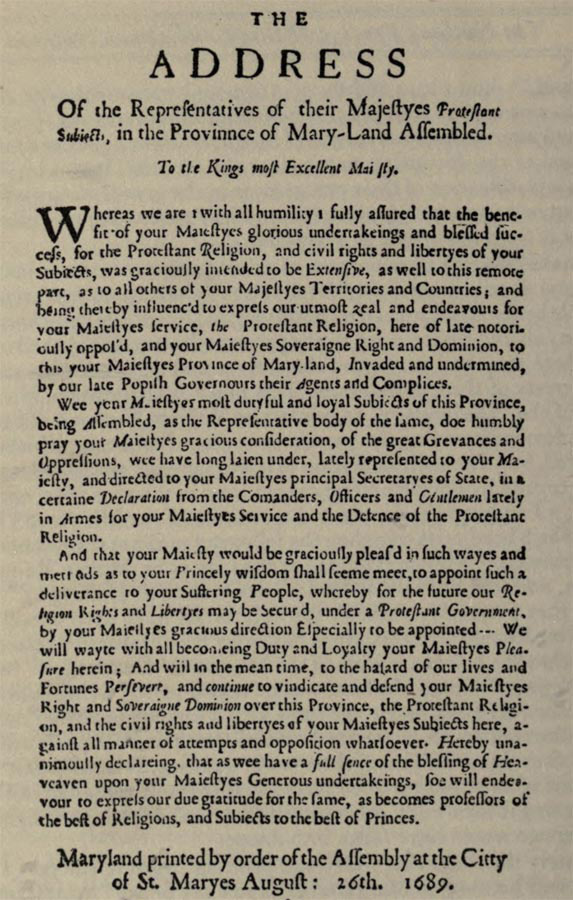
This document, the Address of the Representatives of their Majesties' Protestant Subjects, in the Province of Maryland Assembled, was written by John Coode after the 1689 rebellion. A version of it was sent to the King and Queen of England, and this version was printed at the St. Mary's City printhouse and distributed to the public.
John Coode (c. 1648-1708/9)
John Coode is best known for leading a rebellion that overthrew Maryland’s colonial government in 1689, but Coode couldn't seem to get along with any government. He was involved in four rebellions and narrowly escaped severe punishment or even death.
Coode was born in Cornwall, England, in 1648. He was born into a wealthy English family and attended Oxford University at 16. In 1669, Coode became an Anglican priest. In 1672, he came to Maryland hoping to become rich or powerful.
Coode served as a minister briefly in the Maryland colony, but he was too ambitious and did not remain a priest for long. He soon gave up the priesthood to marry a wealthy widow named Susannah Slye. Susannah’s father, Thomas Gerrard, was an important man in the colony, but he really did not like the Calvert family who ruled Maryland. Gerrard's dislike for Maryland's rulers most likely helped to turn John Coode against the government.
After his marriage to Susannah, John Coode became more respected in society. He was appointed a captain of the militia, a justice in St. Mary's County, and won election to Maryland's Assembly. He had many opportunities in life, but Coode was still not satisfied. In 1681, he took part in his first rebellion against the government.
It is not known exactly what role Coode played in the rebellion plot. After the plot's failure, he was removed from office and viewed as an enemy of the Calverts. Coode's next rebellion was more successful. An increasing number of Protestants had been moving to Maryland, and they resented the fact that most political offices were held by Catholics or other close friends of the Calverts. Many Protestants were also upset because Maryland's government had not yet recognized the new Protestant king and queen of England, William and Mary, the royals that the College of William and Mary in Williamsburg, Virginia, is named after. In the Glorious Revolution of 1688, William and Mary took power from King James II, a Catholic.
In April 1689, John Coode helped lead an alliance of rebels to defend the Protestant religion and the right of King William and Queen Mary to lead the Province of Maryland. Coode did not have much trouble raising an army to fight against Maryland's Catholic leaders. This is in part because he and the other rebel leaders started a rumor that the Catholics had invited the local tribes to come and kill the Protestants.
One of the first steps Coode and his followers took was to attack the state house, a symbol of the proprietary government's authority and home to the colony's records. Coode's army of 700 men marched into St. Mary's City and forced the council to surrender power. The rebels gained control of Maryland.
Coode briefly served as governor of Maryland from 1689 to 1690 until a new royal governor was appointed. For a while, Coode participated in the new government, but he became dissatisfied again. He participated in two more uprisings against the government, and in 1699 it seemed that Coode would be punished for his opposition.
Coode had said bad things about the Christian religion, and was put on trial for blasphemy. A jury found him guilty and sentenced him to pay a 20-pound sterling fine and to have a hole bored through his tongue with a red-hot iron for “using it against God.” Fortunately, Governor Blackiston pardoned him in respect for his past service in the rebellion of 1689.
Coode remained popular with some of his neighbors in Maryland who tried to elect him to the Assembly, but the council used the fact that he had once been a priest to keep him out of the government until his death in February or March of 1709.
« Back to Library Collection
Sources:
Carr, L. G., & Jordan, D. W. (1974). Maryland's revolution of government, 1689–1692. Cornell University Press.
Papenfuse, E. C., Day, A. F., Jordan, D. W., & Stiverson, G. A. (1979–1985). A biographical dictionary of the Maryland legislature, 1635–1789 (Vols. 1–2). Johns Hopkins University Press.
Scharf, J. T. (1967). History of Maryland from the earliest period to the present day (Vols. 1–3). Tradition Press. (Original work published 1879)