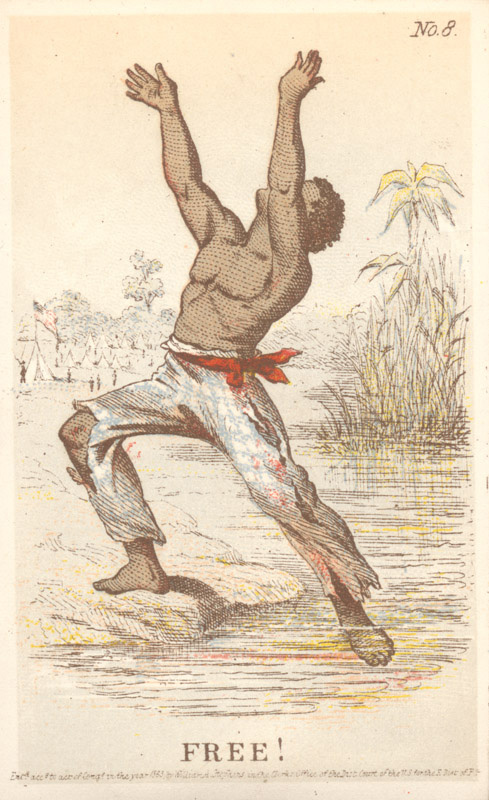
A color print of an African American man celebrating his freedom, created in 1863. There are no known images of John Babtist.
John Babtist
The first men of African heritage came to Maryland under the 1632 Charter of Maryland, arriving in March 1634 with Governor Leonard Calvert. In that group were Catholic missionary Father Andrew White, who brought Matthias Sousa, a man of Portuguese and African ancestry, and brothers Edward and Frederick Wintour, who brought with them "black John Price."1 These men were thought to be indentured servants.
Although the Maryland colonial assembly did not make slavery legal until 1664, there was evidence of it before then2. An early case from 1653 shows how an indentured servant was treated as enslaved simply because he was Black. In March of that year, John Babtist petitioned Maryland’s Provincial Court for his freedom. He argued that Major Thomas Lumbert could not keep him enslaved because the man he served before, Simon Overzee, had not sold him “for his lyfe time.”3 Babtist did not have written proof, but several witnesses had seen the sale and spoke for him in court. The Court ruled in Babtist’s favor, although it ordered him to pay a fee or work for two more years before earning his freedom.4
2Ibid.
3Browne, W. H. (Ed.). (1883–present). Archives of Maryland (Vol. 41, pp. 499–500). Maryland Historical Society.
4Catterall, H. T. (Ed.). (1926). Judicial cases concerning American slavery and the Negro: Vol. 4. Carnegie Institution of Washington. https://archive.org/details/volume4judicialc00unse/page/8/mode/2up
« Back to Library Collection